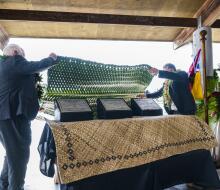
Memorial headstones recognise Niuean First World War servicemen
27 August 2026
Unfortunately you are viewing this website on an outdated browser which does not support the necessary features for us to provide an adequate experience. Please switch to a modern browser such as latest version of Google Chrome, Mozilla Firefox, Apple Safari or Microsoft Edge.
Ngā mihi nui
The Belgium grave of a previously unknown New Zealand soldier of the first World War has been rededicated with his name in a ceremony on November 6.
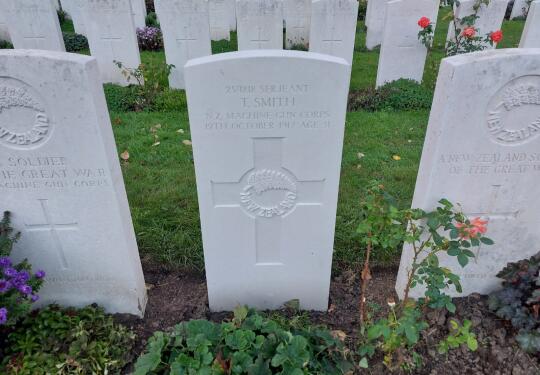
Sergeant Thomas Smith, who died in the Battle of Passchendaele on 12 October 1917, had been lying in an unmarked grave marked “Unknown Serjeant of the New Zealand Machine Gun Corps” in Tyne Cot Cemetery, Belgium.
New research from independent, volunteer researchers conducted in 2019, along with further information from the Commonwealth War Graves Commission (CWGC) and New Zealand Defence Force (NZDF) historians revealed the final resting place of Sergeant Smith, along with another ‘unknown’, Corporal Thomas McFarland, who also died at Passchendaele.
In 2025 a TVNZ Seven Sharp and NZDF appeal for descendants of the ‘two Thomases’ resulted in locating Auckland-based relatives of Corporal McFarland, who went on to attend his rededication ceremony in Belgium in July this year.
Sadly, there were no relatives attending Sergeant Smith’s ceremony. He left behind no children and despite considerable research and a NZDF appeal, NZDF historians were unable to trace a descendent.
Instead, Sergeant Smith was represented by staff and pupils from the Duke of York Royal Military School in Kent, which Smith attended from 1895 to 1899, honouring him as a ‘lost boy’ – a former student lost to war.
Captain James Barnes RNZN, New Zealand Defence Attaché to Belgium, organised the event and attended as Master of Ceremonies.
He noted the poignancy of Sergeant Smith’s grave having the only newly named headstone in a section where eight others are unnamed.
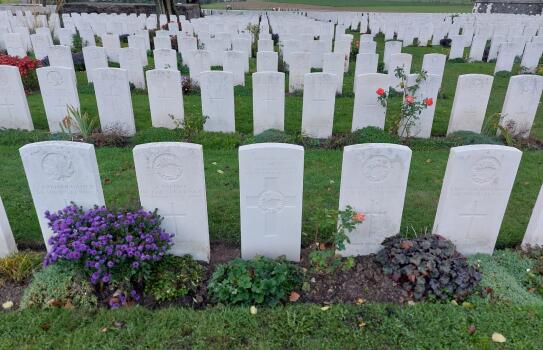
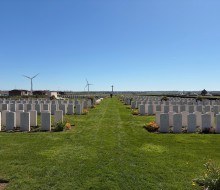
Sergeant Thomas Smith’s new headstone in the centre, among other headstones indicating the burial of an unknown soldier at Tyne Cot Cemetery, Belgium.
“This section includes two Canadians, six Kiwis and an unknown, whom I suspect was either a New Zealander or Canadian because they would have come in together.
“So it’s significant to identify Smith and especially noteworthy that he is the second of two we are doing this year.”
Captain Barnes gave an insight into Sergeant Smith’s life.
He was born in Alverstoke, England. His father had served more than 22 years in the 9th Regiment of Foot (East Norfolk Regiment).
From the turn of the century Sergeant Smith served in the Royal Navy, British Army and Merchant Navy, likely falsifying his age to suit circumstances.
He was a merchant seaman living in New Zealand when he enlisted into the New Zealand Expeditionary Force in 1915. He embarked from New Zealand with the 11th Reinforcements, and first served in 4th Battalion, New Zealand Rifle Brigade. He was wounded in action in France in September 1916, and upon leaving hospital he joined the New Zealand Machine Gun Corps.
He was killed on what is known as New Zealand’s ‘blackest day’, when his unit took part in the New Zealand Division’s disastrous attack on Bellevue Spur.
During the attack at least 846 New Zealanders were killed in action in a matter of hours - the highest number of New Zealanders to die in battle on a single day - with many more dying of wounds over the following days and weeks.
Tyne Cot Cemetery contains the burials of nearly 12,000 Commonwealth servicemen from the First World War, including more than 500 New Zealanders.
The Tyne Cot Memorial within the cemetery commemorates nearly 35,000 servicemen who died in the Ypres Salient after 16 August 1917 and whom have no known grave, including nearly 1,200 New Zealanders.
27 August 2026
05 May 2026
25 April 2026
23 April 2026
14 May 2025
09 May 2025
22 April 2024
26 April 2026
25 April 2026