Taupō trumpeter in demand in brand new career with Royal New Zealand Navy Band
26 August 2025
Unfortunately you are viewing this website on an outdated browser which does not support the necessary features for us to provide an adequate experience. Please switch to a modern browser such as latest version of Google Chrome, Mozilla Firefox, Apple Safari or Microsoft Edge.
Ngā mihi nui
New Zealand Army Lance Corporal Tyrone Stewart has relished the opportunity to work alongside the United States Air Force (USAF) during the recent Royal New Zealand Air Force (RNZAF) Exercise Mobility Astra based out of Woodbourne.
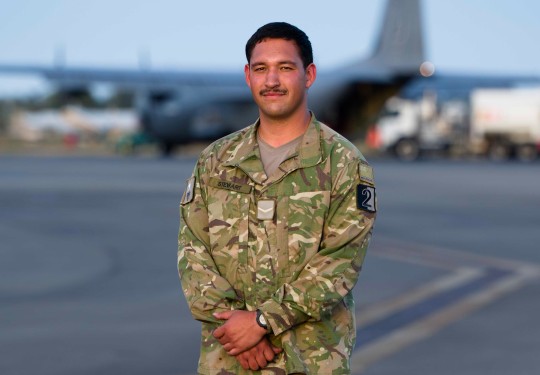
Conducted out of RNZAF Base Woodbourne in Marlborough, the exercise involves C-130J Hercules aircraft from the RNZAF, Royal Australian Air Force (RAAF) and USAF, and focuses on low-level flying, aerial delivery for combat sustainment and humanitarian assistance and disaster relief.
Lance Corporal Stewart attended Te Karaka Area School, near Gisborne, joining the Army initially as a gunner in 2016, before changing to a movement operator in 2021.
Movement operators specialise in the strategic logistics of moving personnel, vehicles, and equipment by road, sea, or air. They are crucial for aerial delivery, managing container loading, and executing terminal operations to support military operations.
“I enjoyed being a gunner. Then two of my friends talked about the qualifications I could receive, the experience and the camaraderie within the [NZ Army Movement] unit.”
Since changing trades, Lance Corporal Stewart has obtained various vehicle licences, port operations qualifications, and airfield and movement control qualifications.
During Mobility Astra, he was part of the team responsible for preparing platforms for military aerial delivery.
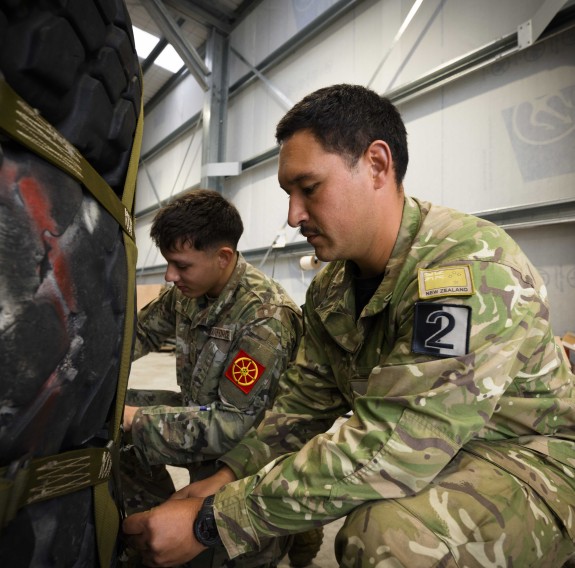
USAF and NZ Army personnel preparing loads to be airdropped by USAF, RNZAF and RAAF C-130J aircraft as part of Exercise Mobility Astra
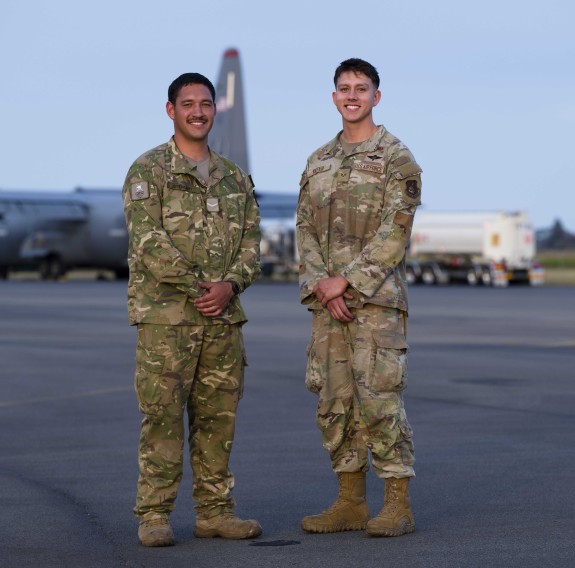
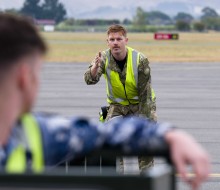
USAF Senior Airman Kiefer and NZ Army Lance Corporal Stewart on Ex Mobility Astra at RNZAF Base Woodbourne
With a USAF rigger from 374th Airlift Wing fully embedded into the New Zealand Army’s 5th Movements Company team throughout the exercise, Lance Corporal Stewart noted there had been few challenges for the two partner nations to successfully work alongside each other.
“We follow the same procedures with just a few minor tweaks, so we work with a similar workflow.
“We’ve got to adapt to change all the time with the different loads, platforms and aircraft so it’s no different to our New Zealand outputs.”
One of the first loads the team rigged was deployed from the rear of a USAF C-130J.
“ It’s the first time we’d done that specific load type and it’s also the first time some of our US counterparts have seen the rigging done this way. To have it successfully land on the drop zone complete shows our procedures work and can be integrated easily with partner nations.”
Embedded USAF rigger, Senior Airman John Kiefer, agrees that sharing the same instructional manual made the process feel easier to merge in with the New Zealanders.
“I’ve spent time observing how the New Zealand team works, and following the same procedures has made it easy to adapt and become one team.”
As second in charge of one of the 5th Movements Company’s rigging crews, Lance Corporal Stewart received the information from the crew commander and prepared the team to rig the load.
“The challenge is remembering which calculations to do, for which platforms, as they need to be exact.”
The calculations include factors such as weight and balance to ensure the load doesn’t cause the aircraft to have balance issues, fuel management for the load, along with wind drift, elevation and drop zone location.
Tie down restraint calculations ensure the load stays in place during both the flight and the drop, and can withstand the heavy gravitational force during transit.
An additional calculation determines how much energy dissipating material is required to protect the load on impact.
Lance Corporal Stewart said the strategic briefs delivered before the exercise made a big impact on the ground for them.
“We’re getting our loads out on time and essentially ahead of the game, which is where we need to be.”
26 August 2025
16 October 2025
09 October 2025
07 August 2025
05 July 2024
31 March 2026
30 March 2026
30 March 2026
26 March 2026