Protocols for military personnel, civilians, and families
The wearing of medals is governed by a number of rules, which vary depending on who’s wearing them, their dress and the type of event. This short guide is designed to demystify medal protocol, and to help New Zealanders wear them appropriately.
Wearing of medals or ribbon bar by serving personnel
Medals awarded to you should be worn on your left chest, following the NZDF Medal Mounting Standard. When wearing ribbons alone, they should be mounted on a bar according to this standard and the Order of Wear. These ribbons are to be placed on the left side of the uniform, just above the breast pocket or in a similar position. Alternatively, ribbons can be sewn directly onto the uniform jacket instead of using a ribbon bar.
Ribbon bars are allowed only on NZDF military uniforms (as specified in Service Orders of Dress), New Zealand Police uniforms, New Zealand Fire Service uniforms, and other official New Zealand agency uniforms. Government agencies may decide that no medals or ribbons should be worn on their uniforms.
Ribbon bars should not be worn with civilian clothes.
See below for information on the wearing of medals by family members.
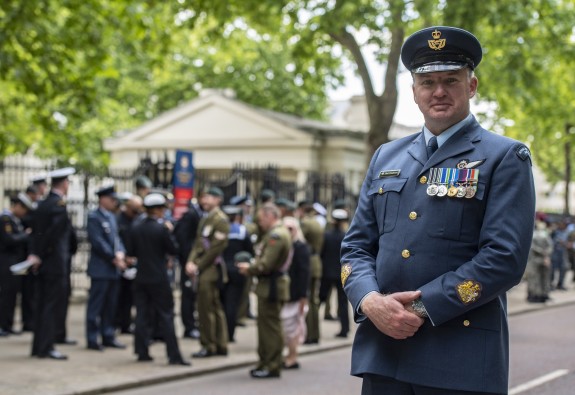
Warrant Officer Paul Chadwick returning to London for the Queen’s Platinum Jubilee Pageant.
Wearing of medals by ex-service personnel
Ex-service personnel who were eligible to wear their medals in uniform may continue to do so in civilian attire on appropriate occasions. Medals should be mounted and worn in the same manner as they would be in uniform.
Miniature medals are designed to provide a more practical and comfortable option when wearing evening attire. However, wearing miniature medals at other times, such as during commemorative services or parades, is not officially recognised for civilians.
Wearing of medals by civilians
Some civilians have been awarded medals for their service to New Zealand, such as the East Timor Medal and the New Zealand Operational Service Medal. These medals should be mounted and worn just as they would be for uniformed wear. Miniature medals are designed to provide a more practical and comfortable option when wearing evening attire.
Wearing of medals by family members
Since the 1990s, it has become common for next of kin and other relatives to wear the medals of deceased service personnel at Anzac Day services. Wearing a deceased relative's medals is appropriate on specific occasions and under certain circumstances for both military and civilian family members of former New Zealand service personnel.
Conventions for wearing a relative’s medals include:
- People should only wear one set of medals, and they should be:
- directly related to their family, for example, should have belonged to a brother or sister, dad or mum, grandfather or grandmother; or
- those of a relative whose medals you have inherited.
Note: It is very common for military personnel who died in the First and Second World Wars to have no children, and for their great-nephews and great-nieces and other family members to inherit their medals through the parents, brothers, and sisters of the deceased military service person. Family members who have inherited medals can wear these medals on Anzac and/or Remembrance days or give permission for another member of the deceased's family to wear these medals.
- In all cases these are worn on the right chest. This differentiates between former service personnel (who wear their own medals on the left chest) and next-of-kin or other relatives (who wear their relative's medals on the right chest).
- Service medals and decorations should be mounted on a medal bar (full-size or miniature). It is perfectly acceptable for people to wear miniature medals mounted on a medal bar as the weight is far easier to handle.
- Royal Honours insignia such as neck badges, sashes, sash badges, or breast stars cannot be worn by anyone other than the original recipient. The same rule applies to any Unit and Personal Commendations that the deceased wore on their right chest.
- The occasions on which wearing of relatives medals is permitted are confined to Anzac Day (25 April) and Remembrance Day (11 November). In addition, it may be appropriate for next-of-kin and other relatives to wear relative's medals on an occasion where either the relative's service or the unit in which they served is being commemorated.
Wearing of lifesaving medals
The award of official Government medals for acts of bravery and self- sacrifice in saving life is only relatively recent. Prior to the introduction of medals such as the Albert and George medals, it was left to private organisations to honour those who risked their lives to save others. Many organisations such as the Royal Humane Society, the Royal National Lifeboat Institution, Order of St John and Lloyds of London as well as cities and both private and public companies struck and issued lifesaving medals.
British lifesaving medals were awarded to New Zealanders until 1998 when a specific range of New Zealand Bravery Awards designed to recognise both military and civilian personnel was instituted. Some organisations such as the Royal Humane Society and Order of St John still continue to issue lifesaving medals in their own right. Medals issued by the British or New Zealand Governments for saving life are assigned a place in the New Zealand Order of Wear and are to be worn with other Honours, Decorations and Medals on the left breast. All other lifesaving medals are to be worn on the right breast.
Wearing of medals by NZ Police, Fire Service and other Government Agencies
The New Zealand Police and the New Zealand Fire Service are government agencies in a country where His Majesty The King is the Head of State. Therefore, all awards approved in the official Order of Wear may be worn on Police, Fire Service, and other official New Zealand agency uniforms. While a government agency may decide that no medals or ribbons are to be worn, they cannot require that only their Long Service and Good Conduct Medal be worn.
Fraudulent wearing of medals
No one may wear medals that have not been awarded to them personally, except as noted in the 'Wearing of Medals by Family Members' section. This rule also applies to miniature medals and medal ribbons.
It is considered acceptable for medals to be worn in theatrical, television, and film productions, and historical re-enactments.
Additionally, no one may wear a medal or decoration awarded by a foreign government unless it has been approved for wear by the Sovereign. Refer to the Military Decorations and Distinctive Badges Act 1918 and its 1974 amendment for more details.