The New Zealand Operational Service Medal
Overview
The New Zealand Operational Service Medal (NZOSM) was instituted in 2002 to recognise New Zealanders who have undertaken operational service since 3 September 1945. Operational service is defined as service exceeding the normal requirements of peacetime, involving a credible military threat from enemy forces, insurgents, or other hostile entities.
The NZOSM is awarded to New Zealand citizens and permanent residents in addition to any New Zealand, Commonwealth, or foreign campaign medals. It is awarded only once to an individual, regardless of how many times they have deployed on operations.
Description
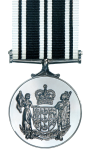
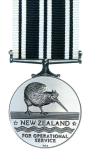
The NZOSM is silver in colour and circular in shape. On the obverse, the New Zealand Coat of Arms indicates that the medal specifically recognises service on behalf of New Zealand. The reverse depicts a kiwi, facing to the right, with the inscription 'FOR OPERATIONAL SERVICE'. The straight line below the kiwi’s feet represents land, the wavy line represents sea and the background field represents air.
The colours of the ribbon allude to those generally regarded as the national colours of New Zealand, black and white. These colours were first adopted by the New Zealand troops in the South African War (1899-1902). They were used for the New Zealand War Service Medal; the New Zealand Service Medal 1946-1949; and the East Timor Medal . The distinctive design makes the statement that it is a New Zealand medal. When worn and overlapped with other medals the distinctive design remains visible.
The NZOSM was issued unengraved until 30 June 2009, except for those who had died on operational service. From 1 July 2009, all NZOSMs have been issued engraved on the bottom rim. For military personnel, the details engraved include the recipient's service number, rank, initials, surname, and corps / service. These details are as at the date of the operational service which qualifies him or her for the NZOSM.
Recipients of an unengraved NZOSM should contact NZDF Personnel Archives and Medals (PAM) if they wish their medal to be engraved. The best opportunity to have your medal engraved is when you need to add another medal (such as the New Zealand Defence Service Medal) to your mounted medal group.
There are no clasps or bars for this medal.
Eligibility
New Zealand citizens or permanent residents who are members of the Armed Forces, New Zealand Defence Force civilians, New Zealand Police, or any other persons whom the Minister of Defence might determine meet the following criteria. Qualifying periods can be aggregated across one or more campaigns.
- Have been awarded a New Zealand, Commonwealth, British, or other non-New Zealand campaign medal for operational service since 3 September 1945, provided that the particular campaign medal has been approved for acceptance and wear by New Zealanders; or who
- Have not completed the qualifying service for a campaign medal, but meet one of the following requirements:
- completed seven days on the posted strength of a qualifying unit;
- completed seven sorties into a qualifying operational area;
- completed seven days on a ship in a qualifying operational area;
- completed thirty days as an official visitor
- For operational service during the Berlin Airlift - 1 September 1948 to 11 August 1949.
- For operational service during the 'Bougainville Peace Conference' - 5 to 19 October 1994.
- For service in Southeast Asia (Malaysia and Singapore) - 25 March 1959 to 1 January 1974 (posted or attached for seven or more days with the Far East Strategic Reserve (FESR), the Australia New Zealand United Kingdom Force (ANZUK) or associated units).
Veterans of the following Royal New Zealand Navy deployments to South East Asia are also eligible for the NZOSM under the 7 days of operational service criteria (listed in chronological order):
- HMNZS Black Prince - June 1955 to July 1955 (for 9 days' operational service during the Malayan Emergency)
- HMNZS Royalist - 25 March 1959 to 10 June 1959 (for 7 days' operational service during the Malayan Emergency)
- HMNZS Otago - 26 November 1961 to 7 December 1961 (for operational service as part of the Far East Strategic Reserve - FESR)
- HMNZS Otago - 23 February 1962 to 26 March 1962 (for operational service as part of the Far East Strategic Reserve - FESR)
- HMNZS Royalist - 14 March 1963 to 26 June 1963 (for operational service as part of the Far East Strategic Reserve - FESR)
- HMNZS Taranaki - December 1963 to August 1964 (for 8 days' operational service during the Indonesian Confrontation)
- HMNZS Royalist - 19 May 1964 to 17 July 1964 (for operational service as part of the Far East Strategic Reserve - FESR)
- HMNZS Blackpool - 8 November 1966 to 21 April 1967 (for operational service as part of the Far East Strategic Reserve - FESR)
- HMNZS Taranaki - 21 April 1967 to 24 November 1967 (for operational service as part of the Far East Strategic Reserve - FESR)
- HMNZS Waikato - 6 December 1967 to 2 May 1968 (for operational service as part of the Far East Strategic Reserve - FESR)
- HMNZS Otago - 10 June 1968 to 24 November 1968 (for operational service as part of the Far East Strategic Reserve - FESR)
- HMNZS Blackpool - 13 January 1969 to 11 June 1969 (for operational service as part of the Far East Strategic Reserve - FESR)
- HMNZS Otago - 10 June 1969 to 23 September 1969 (for operational service as part of the Far East Strategic Reserve - FESR)
- HMNZS Waikato - 11 December 1969 to 15 February 1970 (for operational service as part of the Far East Strategic Reserve - FESR)
- HMNZS Taranaki - 20 February 1970 to 10 August 1970 (for operational service as part of the Far East Strategic Reserve - FESR)
- HMNZS Otago - 15 August 1970 to 20 December 1970 (for operational service as part of the Far East Strategic Reserve - FESR)
- HMNZS Otago - 18 March 1971 to 19 November 1971 (for operational service as part of the Far East Strategic Reserve - FESR)
- HMNZS Waikato - 11 December 1971 to 31 March 1972 (for operational service as part of the Australia New Zealand United Kingdom (ANZUK) Force)
- HMNZS Taranaki - 3 May 1972 to 9 September 1972 (for operational service as part of the Australia New Zealand United Kingdom (ANZUK) Force)
- HMNZS Waikato - 4 September 1972 to 4 January 1973 (for operational service as part of the Australia New Zealand United Kingdom (ANZUK) Force)
- HMNZS Otago - 29 January 1973 to 3 April 1973 (for operational service as part of the Australia New Zealand United Kingdom (ANZUK) Force)
- HMNZS Taranaki - 30 March 1973 to 11 July 1973 (for operational service as part of the Australia New Zealand United Kingdom (ANZUK) Force)
- HMNZS Otago - 29 November 1973 to 30 January 1974 (for operational service as part of the Australia New Zealand United Kingdom (ANZUK) Force)
For full details:
Royal Warrant for the New Zealand Operational Service Medal(external link)
Regulations for the New Zealand Operational Service Medal(external link)
Recipients
To date, the NZOSM has been issued to over 30,000 veterans, current serving military personnel and civilians. It is estimated that over 40,000 New Zealanders are eligible for this medal.
Queries & requests
-
Wearing this medal
The New Zealand Operational Service Medal is worn before all other operational medals awarded for service since 3 September 1945 in the New Zealand Order of Wear.
For more information on the wear and care of honours, medals and awards:
-
Applying for this medal
NZDF Personnel Archives and Medals (PAM) issues war, operational and service medals to current and former NZDF members.
If you or someone you know may be eligible, you can apply through our application page.
-
Checking if this medal was issued
Honours, medals, and awards bestowed on an individual for service in the New Zealand Armed Forces are recorded in their individual service record. NZDF Personnel Archives and Medals holds a collection of about 1.5 million service records relating to 420,000 New Zealand service personnel who served in New Zealand’s Military Forces after the First World War.
Service records are not currently digitised, but we can locate it and find the information you might be looking for or help you book a time for you to see the records in Trentham by completing the form on the Service Record page.
-
Related questions
Is the New Zealand Operational Service Medal ever awarded without a campaign medal?
Yes. The New Zealand Operational Service Medal (NZOSM) is awarded for seven days' service, while a campaign medal is usually awarded for 30 days' service. For example, if you served 20 days in an operational area, you may be eligible for the NZOSM without a campaign medal.
Can qualifying days for the New Zealand Operational Service Medal be accumulated across one or more campaigns?
Yes. Qualifying days can be aggregated across one or more campaigns. For example, if you served three qualifying days in one operational area and four days in a different operational area at another time, you may be eligible for the NZOSM. Official visitors must accumulate 30 days.