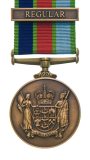
The New Zealand Defence Service Medal
Overview
Instituted in 2011, the New Zealand Defence Service Medal (NZDSM) is awarded for military service of three years or more since 3 September 1945. Service in the Regular Force, Territorial Forces (Army, Navy and Air), Compulsory Military Training (CMT), and National Service is recognised.
The medal recognises the unique requirements of military service, including commitment to service of the Crown, liability for operational service subject to military discipline and lifestyle, and imposed constraints on employment conditions and personal freedoms.
Description
The medal is in bronze and circular in shape. On the obverse is the New Zealand Coat of Arms, which is the symbol of the Crown and Executive Arm of Government, and which indicates that the medal specifically recognises service on behalf of New Zealand. The reverse features one large New Zealand fern frond on the right and, on the left, the emblems of the Navy, Army, and Air Force - the Naval crown, crossed swords, and eagle. "THE NEW ZEALAND DEFENCE SERVICE MEDAL" is inscribed below the images.
The ribbon has three wide bands of dark blue, red, and light blue, separated by narrow bands of light green. Dark blue, red, and light blue reflect the colours of the Navy, Army, and Air Force respectively. The light green stripes represent the volunteer and territorial elements of the Services.
There are four clasps that can be awarded: REGULAR, TERRITORIAL, C.M.T., and NATIONAL SERVICE. The medal is issued with one or more clasps determined by the type(s) of military service undertaken by the individual.
When only ribbons are worn, a small silver rosette is worn on the NZDSM ribbon to represent the award of a second clasp. Two small silver rosettes are worn on the ribbon to represent the award of three clasps.
Eligibility
Eligibility for the New Zealand Defence Service Medal (NZDSM) varies by clasp:
- NZDSM with 'REGULAR' Clasp
- Completion of three years of Regular Force service, accumulated or continuous, since September 3, 1945
- Completion of an initial Regular Force engagement of 12 months or more which began after 3 September 1945.
- Completion of two years Regular Force Service and one efficient training year in the Territorial Forces.
- NZDSM with 'TERRITORIAL' Clasp
- Completion of three years of efficient service, accumulated or continuous, in the Territorial Forces of New Zealand (Army, Navy, or Air Force) since 3 September 1945.
- Completion of an initial Territorial Force engagement of 12 months or more which began after 3 September 1945.
- Completion of one year of Regular Force service and two efficient training years in the Territorial Forces of New Zealand.
- NZDSM with 'C.M.T' Clasp
- Completion of the individual's obligations under the Military Training Act 1949 and Amendments.
- Historical Note: There were 27 intakes of personnel for Compulsory Military Training (CMT) personnel between May 1950 and July 1958, with the scheme formally closed in March 1959. About 63,000 men served in CMT.
- NZDSM with 'NATIONAL SERVICE' Clasp
- Completion of the individual's obligations under the National Military Service Act 1961 and Amendments.
- Historical note: There were 31 intakes of personnel for National Service Training, which ran under the National Service scheme from May 1962 to December 1972. More than 28,000 men served in National Service.
- Special case criteria for deserving service of less than three years include but are not limited to:
- Those Second World War personnel who were still serving (in New Zealand or overseas) on or after 3 September 1946 (that is, 12 months after the end of the Second World War.)
- J Force and K Force personnel who completed their obligations for service in Japan or Korea.
- Death during service.
- Medically discharged due to a total and permanent disability, before completing three years of service.
- Medically discharged for any other reason after 12 months of service.
- Discharged through no fault of their own when their service was no longer required as a member of the Armed Forces.
- Discharged due to a prevailing discriminatory policy, such as pregnancy or sexual orientation.
- Discharged from the CMT scheme when it ceased in 1959 or discharged from the National Service scheme when it ceased in 1972
The NZDSM is the largest medal issue project undertaken in New Zealand since 1950-1954 when the majority of the Second World War medals were issued. Over 120,000 NZDSMs have been issued. NZDF estimates that an additional 40,000 ex-Service personnel are eligible to receive the NZDSM.
For full details:
The Royal Warrant for the New Zealand Defence Service Medal(external link)
The New Zealand Defence Service Medal Regulations 2011(external link)
Queries & requests
-
Related Publications
-
Wearing this medal
The New Zealand Defence Service Medal is worn after Long Service Awards and before Foreign Awards in the New Zealand Order of Wear.
For more information on how to wear and care for honours, medals, and awards:
-
Applying for this medal
NZDF Personnel Archives and Medals (PAM) issues war, operational and service medals to current and former NZDF members.
If you or someone you know may be eligible, you can apply through our application page.
-
Checking if this medal was issued
Honours, medals, and awards bestowed on an individual for service in the New Zealand Armed Forces are recorded in their individual service record. NZDF Personnel Archives and Medals holds a collection of about 1.5 million service records relating to 420,000 New Zealand service personnel who served in New Zealand’s Military Forces after the First World War.
Service records are not currently digitised, but we can locate it and find the information you might be looking for or help you book a time for you to see the records in Trentham by completing the form on the Service Record page.