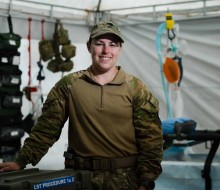
Nelson anaesthetist and soldier part of large multi-national exercise
04 May 2026
Unfortunately you are viewing this website on an outdated browser which does not support the necessary features for us to provide an adequate experience. Please switch to a modern browser such as latest version of Google Chrome, Mozilla Firefox, Apple Safari or Microsoft Edge.
Ngā mihi nui
The New Zealand Army Reserve Force has enabled Medic Selma Roberts to spread her drive to serve others far beyond her Central Otago home.
Corporal Selma Roberts, from Arrowtown, is a medic with the Royal New Zealand Army Medical Corps, working for the Southern Health Support Squadron and based with a 2nd/4th Battalion, Royal New Zealand Infantry Regiment (RNZIR) sub-unit in Cromwell.
In civilian life, she is a mother, a first aid tutor for Hato Hone St John and a library contractor with the Queenstown District Council.
But as one of few Army medics in Central Otago, she supports military exercises in the region and has deployed to the Pacific Islands to support humanitarian efforts.
Raised in Germany near the Belgian border, in an area still marked by remnants of the Second World War, she developed an early interest in the Army and often spent time exploring the local forests with her brothers.
She wanted to join the Bundeswehr infantry but back then women were banned from combat roles.
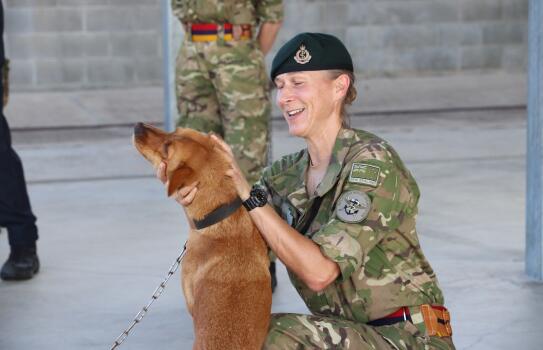
After studying biology, she moved to New Zealand to undertake medical research where a colleague’s friend, who served as an Army Reserve Force medic, invited her to attend a training session. She enlisted as soon as she could.
“I love it. I love belonging to something bigger than myself, and I really love the camaraderie.
“In Central Otago there are people who have been in the Army for years. You become part of a big family.”
Corporal Roberts helps provide medic capability when 2/4 RNZIR are on exercise and runs medical training in Cromwell during parade nights. The medics in turn provide ‘patients’ during exercises.
But there have also been real-world responses.
Corporal Roberts was part of a 2/4 RNZIR team assisting residents in Balclutha, which was battered by severe winds and power outages in October last year.
She has also deployed to a remote part of the Cook Islands as part of Exercise Tropic Twilight, which she described as hugely rewarding and meaningful.
“We were based on Pukapuka, the northernmost atoll of the Cook Islands. We had engineers with us who repaired the local school roof and restored a cyclone-damaged runway, while dental staff provided treatment for local children.
“As part of the health team, I helped conduct a community health survey and trained selected individuals in basic first aid.”
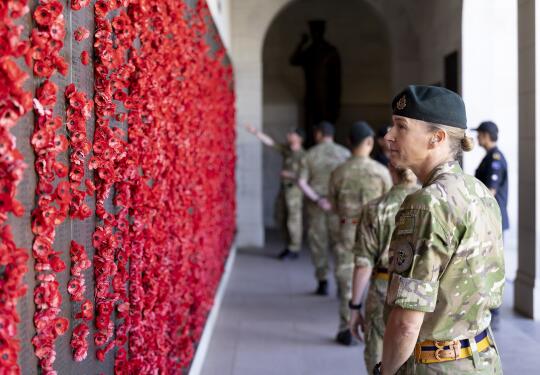
She has also recently returned from Exercise Tasman Scheme, a Reserve Force exchange with Australian Defence Force reserve units, which is focused on interoperability and cooperation.
Corporal Roberts wants to raise awareness of the NZ Army presence in Central Otago.
“It’s like the classic advertisement says – you get the best of both worlds in the Reserves.
“The opportunities are amazing. You’re a part-time soldier but you can also complete first aid courses, gain heavy vehicle licences, take part in leadership courses, participate in sporting events, and of course go on exercises and deployments.
“The life skills and experiences gained through serving in the Army Reserves are deeply enriching and stay with you forever.”
Reserve Force personnel like Corporal Roberts play a critical role in delivering operational capability, supporting both domestic responses and international engagements alongside their Regular Force counterparts.
Each Reserve Force company has its own training programme in line with its Battalion’s training focus. Company led training typically occurs one weekend a month with platoon-level training occurring once a week.
More information on the New Zealand Army Reserve Force is available at www.defencecareers.mil.nz(external link) or phone 0800 1 FORCE
04 May 2026
13 October 2026
12 October 2026
26 August 2025
09 October 2026
14 August 2026
27 July 2026
16 July 2026
08 July 2026