Tokoroa teenager holds his head high, and aims even higher following Navy graduation and topping class
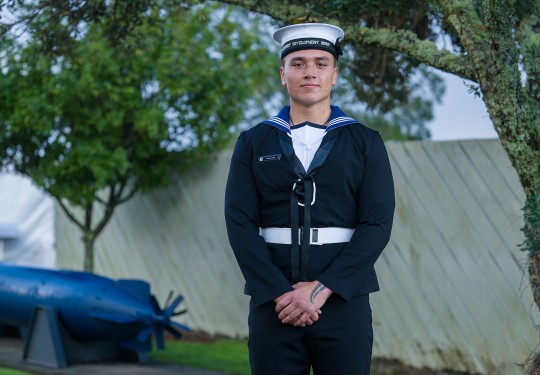
Ordinary Marine Technician Rodger Griffin says his hometown of Tokoroa is a place where people are renowned for helping others.
09 June, 2026
And it’s that giving back that he wants to carry on as a sailor in the Royal New Zealand Navy (RNZN).
Ordinary Marine Technician Griffin, 19, was one of 61 men and 23 women to graduate from Basic Common Training (BCT) intake 26/1 at a joint officer and sailor graduation at Devonport Naval Base in Auckland on Saturday.
He was awarded the Spencer Tewsley Cup as the best all-round BCT sailor from Defence Minister Chris Penk.
He believes his family, celebrating his graduation, will see a new sense of pride in him.
“Since joining the RNZN even I’ve found that I’ve started to puff my chest out a little more and hold my head a little higher than I ever have before.”
He entered the Navy after finishing at Tokoroa High School, where he was a member of the school’s Service Academy, and working part-time for a year in retail.
“There’s an entire list of things that prompted me to join the RNZN – pay, benefits, travel.
“But the two biggest reasons were to help people and to follow a similar engineering career to my father.
“In Tokoroa, we’re famous for reaching out a helping hand and showing aroha to anyone we meet. It’s an environment that raised me to want to help others.
“As I got older, I learned more about our Navy’s work with humanitarian and disaster relief and peacekeeping operations and I thought I’d like to be a part of an organisation like that.
“My dad worked as a mechanical engineer on the dams in Waikato and I was inspired to look into similar trades. I saw the Marine Technician trade in the navy and was instantly hooked.”
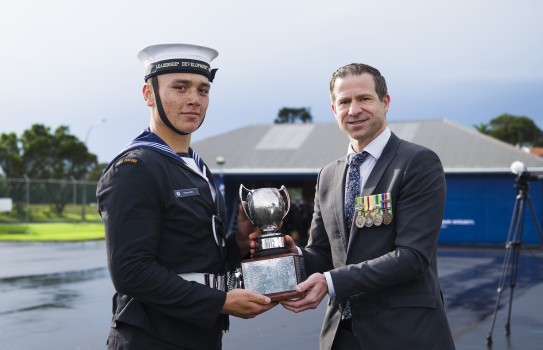
He receives the Spencer Tewsley Cup from Defence Minister Chris Penk, as the best all-round trainee in BCT 26/1.
Marine Technicians operate and maintain a ship’s engine and drive systems, power generation and distribution systems, ensuring a ship remains fully operational and ready to respond.
Sixteen weeks of basic training in Auckland was a big change of scene, he said.
“You’re sharing your living space in barracks, wearing a uniform from 0530 to 2200, having scheduled meals and making your bed. Plus, it’s being separated from my family for longer than ever before.
“The best way to handle it is knowing you’re not going through it alone – my ‘oppos’ (shipmates) are going through it too.
“And the best moments of the course are with your oppos. It could be playing touch on Ngataringa sports field during our marae visit, talking to them in the boot locker about anything and everything, and even being right next to them while re-doing a task, or running in the field - every moment I’ve spent with my oppos is one I would consider the best.”
His advice to others is just do it.
“I’ve only been in for 16 weeks, but I’ve loved every single second of it. All the more experienced sailors I’ve talked to have the same sentiment about their time as a BCT. I’m looking forward to achieving promotion and gaining my trade qualifications as a marine technician.”