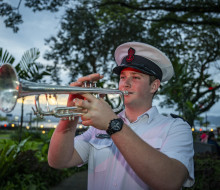
Taupō trumpeter in demand in brand new career with Royal New Zealand Navy Band
26 August 2025
Unfortunately you are viewing this website on an outdated browser which does not support the necessary features for us to provide an adequate experience. Please switch to a modern browser such as latest version of Google Chrome, Mozilla Firefox, Apple Safari or Microsoft Edge.
Ngā mihi nui
Communication on the battlefield is often pivotal for mission success.
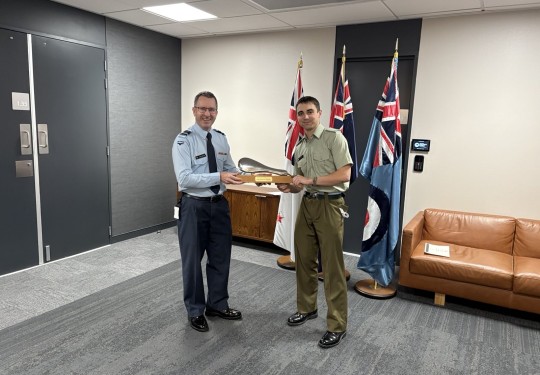
That’s why a new design for a significantly cost-effective solution for the secure tracking of friendly forces has earned New Zealand Army Signaller Benjamin Haddley the 2025 New Zealand Defence Force Innovation of the Year award.
SIG Haddley’s idea is to integrate the civilian system, Meshtastic, into the military. It uses long range radios with inbuilt GPS, which connect with each other to give Command an overall picture of where their forces are located.
“It’s like each troop has the equivalent of an Apple air tag that communicate with each other and send that information to commanders, who can see in real-time a map of where their people are,” he said.
The current system relies on manual reporting, where there can be challenges around accuracy, radio congestion and no live tracking options.
“By using encrypted links and controlled access, the Meshtastic system reduces the risk of an adversary accessing or manipulating location information.
“There can be a large number of radios being used where one might not be able to connect with another further away, but radios in between act as a relay for the information, which allows for encrypted communication between all devices.”
A further and important aspect of the system is that it delivers information at a fraction of the cost of similar high-end tracking systems, meaning it could be rolled out across a large range of users, cheaply and quickly.
“We’re looking at the difference between $100,000 per radio, to $100 per radio.”
SIG Haddley, who’s posted to 2nd Signal Squadron at Linton Military Camp, tested his idea in central Wellington after buying five of the long range radios.
“We put one on top of Defence House, and we didn't even put a proper antenna on it, and then we walked around the city and were able to talk to each other. I also tested it with a more expensive radio system and we could see on the map they were struggling to accurately give back their location data.
“The cheaper civilian system ended up being better and able to give more accurate GPS data,” he said.
SIG Haddley’s award citation said he had identified a critical challenge in his work and proactively addressed the risks posed.
“He developed a low-cost solution that had the potential to deliver significant benefits, such as improved situational awareness, reduced operator workload, secure communications, and timely, accurate data to support mission-critical and potentially life-saving decisions.
“In today’s operational geopolitical environment, the ability to adapt and adopt new technologies is essential for delivering future capability.”
SIG Haddley recognised that alongside traditional high-capability high-cost military-specific systems, there was an important role for cheap, simple technology that could be put in the hands of the warfighter quickly, and in large quantity, the citation said.
26 August 2025

16 October 2025

09 October 2025
07 August 2025
05 July 2024
31 March 2026
31 March 2026

30 March 2026

30 March 2026