Nelson anaesthetist and soldier part of large multi-national exercise
04 May 2026
Unfortunately you are viewing this website on an outdated browser which does not support the necessary features for us to provide an adequate experience. Please switch to a modern browser such as latest version of Google Chrome, Mozilla Firefox, Apple Safari or Microsoft Edge.
Ngā mihi nui
Empowering soldiers through tradition, drill and core infantry training is a driving force for Warrant Officer Class One (WO1) Regan Cherrington.
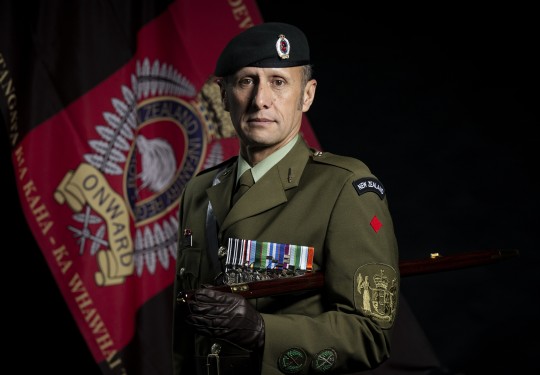
WO1 Cherrington, the Regimental Sergeant Major (RSM) of the Waikato, Bay of Plenty, Auckland and Northland region’s Reserve Force 3rd/6th Battalion, Royal New Zealand Infantry Regiment (RNZIR), brings bi‑cultural heritage to his service, reflecting the inclusive values and traditions of today’s army. From Ngāpuhi iwi, with his hapū being Ngāti Hine, he maintains a deep connection to Te Tai Tokerau. His whakapapa also includes an English ancestor who served with the British Army’s 58th Regiment of Foot, who fought at the Battle of Ruapekapeka in the 1840s. After leaving the British Army and settling in New Zealand, he married WO1 Cherrington’s Māori ancestor.
“For me, that history is deeply meaningful. My whakapapa reflects two cultures that once stood on opposite sides of conflict, yet both are tied to service, duty and commitment to our nation,” WO1 Cherrington said.
“Wearing the uniform today, I carry that shared history with pride and a responsibility to honour it through how I lead and serve.”
He emphasises to soldiers the responsibility that comes with wearing the uniform.
“Once you wear a New Zealand Army uniform, it’s important that you live by those values and ethos throughout your life. Ultimately, all uniformed personnel—Reservists and Regular Force alike—are here to protect our way of life.”
As the senior Warrant Officer, the RSM is the principal advisor to the Commanding Officer on battalion morale, operational effectiveness and personnel management.
The role also includes maintaining discipline, advising on training matters, monitoring wellbeing, providing mentorship, and ensuring high standards, customs and traditions are upheld.
As an infantry battalion, training remains predominantly warfighting focused.
“Soldiers and officers may be required to deploy on operations and integrate into the Regular Force when required,” he said.
Reservists also play a key role in domestic emergency response. Recently, 3/6 RNZIR supported civil authorities during severe flooding in Northland and the Bay of Plenty.
“Army training requires decisiveness, and that is no different in disasters. That mindset is a strength Reservists bring when supporting vulnerable communities.”
WO1 Cherrington recently served in the Colour Party at the Royal Edinburgh Military Tattoo, applying drill and tradition on an international stage. The experience reinforced the pride he holds in his soldiers and the value they place on battalion heritage, dress and bearing
Seven members of 3/6 RNZIR took part alongside more than 1,000 participants from more than 12 countries, parading the Colours before a combined audience of approximately 75,000 people over three nights at Auckland’s Eden Park.
“Military drill and embracing tradition are incredibly positive for individuals and units, including self‑discipline, unit performance, morale and teamwork,” said WO1 Cherrington.
Reflecting on his military service, WO1 Cherrington said, “Growing up within a bicultural lineage shaped by military service, my connection to the profession of arms is both inherited and deeply personal. It carries pride rooted in whakapapa, a sense of duty learned through example, and honour earned through conduct rather than recognition.”
WO1 Cherrington, who first joined the Reserves in 1994 and then soon the Regular Force, was posted to 3rd/6th Battalion more than 15 months ago.
“I often reflect on my time in the Reserves and the people who trained me as a junior soldier,” he said.
“They invested their time in us, and that’s something I keep in mind when working with our soldiers today.”
WO1 Cherrington said, “Military service was never viewed as a career of convenience, but a calling—an act of servitude to whānau, comrades, and country.
“While I recognise this path is not for everyone, it demands commitment beyond self-interest. Many may be called, but few are willing to bear the responsibility that true service requires. Leaders are also teachers.”
WO1 Cherrington commutes home to Whangārei every two weeks and his uniform often prompts curiosity and conversation.
“My neighbours regularly see me in uniform, and it’s been a great way to help raise the profile of Reservists in our region, as there aren’t many currently serving in Northland.”
Each Reserve Force company operates its own training programme aligned with the battalion’s training focus. Company‑level training typically takes place one weekend per month, with platoon‑level training conducted weekly.
Each year, Reserve Force units from across New Zealand take part in Exercise Tauwharenīkau, supported by the Regular Force.
This collective activity complements routine weekend training and evening parades conducted throughout the year.
04 May 2026
13 October 2026
12 October 2026
26 August 2025

09 October 2026
14 August 2026
27 July 2026
16 July 2026
08 July 2026