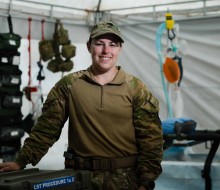
Nelson anaesthetist and soldier part of large multi-national exercise
04 May 2026
Unfortunately you are viewing this website on an outdated browser which does not support the necessary features for us to provide an adequate experience. Please switch to a modern browser such as latest version of Google Chrome, Mozilla Firefox, Apple Safari or Microsoft Edge.
Ngā mihi nui
Months before around 50 New Zealand Defence Force (NZDF) personnel arrived on isolated Penrhyn in the Cook Islands, Kaitaia’s Sergeant Noeline James was already working through what it would take to keep them fed, housed, and equipped.
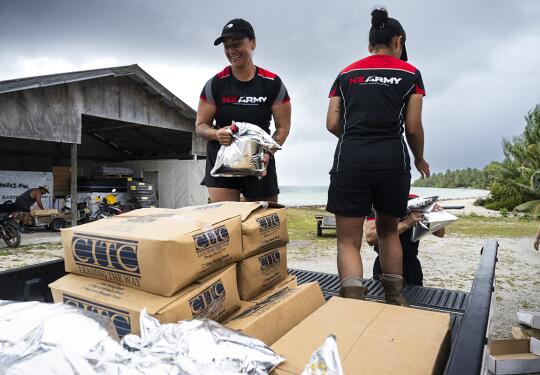
As a New Zealand Army Supply Technician, her role was to make sure the contingent for Exercise Tropic Twilight had what it needed to operate from the moment it arrived.
Tropic Twilight is a long-standing annual New Zealand Defence Force-led South Pacific humanitarian assistance and disaster relief effort, supported by the Ministry of Foreign Affairs and Trade.
This year’s exercise ran from early September to mid-October and carried out infrastructure, health, hydrographic support work nearly 1,400km north of Rarotonga.
“Our main role is to supply and sustain. To get everyone everything that they need in order to do their job and then sustain them for the length of time it takes to complete the tasks,” Sergeant James said.
For Tropic Twilight, that amounted to approximately 20,000 litres of drinking water, 2,000 ration packs, 10,000 litres of diesel, around 160 cubic metres of freight (roughly the volume of five 20-foot shipping containers), and everything from major equipment such as the Royal New Zealand Navy Zodiac boats down to 36,520 screws.
The scale of the task was made more complicated by Penrhyn’s remoteness.
Most construction materials came from Rarotonga by a four-day barge journey, while personnel, specialist tools and other priority items were delivered by Royal New Zealand Air Force C-130J Hercules.

Sergeant Noeline James moving supplies on Penrhyn during Exercise Tropic Twilight where logistics was crucial for its success
“We had to really prioritise what was coming in,” Sergeant James said.
The planning also involved evaluating available accommodation, power and water supplies and what could be bought locally.
The answers to those questions then fed into calculations for food, water, transport, construction materials and contingency stocks.
Just as important was ensuring the NZDF’s presence did not create problems for the people it was there to support. Defence freight could not shunt out local supplies.
“We don’t want to take any supplies out of the store that will then hinder that island,” she said.
Sergeant James grew up in Kaitaia and attended Kaitaia College before joining the NZ Army in 2005, initially as an administrator, before changing trade to become a Supply Technician.
After about 10 years she retrained as an electrician, and worked that trade for around seven years before returning to logistics.
Part of the appeal of the Supply Technician trade was the variety, with personnel posted across different Army units and required to learn the equipment, stores and operating requirements of each one, she said.
“Our systems stay the same, but the supplies, the materials and how we operate with them always changes.”
Working with engineers meant a strong focus on construction materials and equipment, but on Tropic Twilight she also had to consider the requirements of medics, other services and international personnel.
For Sergeant James, successful logistics is often most obvious when nobody has to think about it.
On Penrhyn, getting to that point required months of planning, multiple organisations, carefully timed freight movements and thousands of individual items arriving in the right place at the right time.
04 May 2026
13 October 2026
12 October 2026
26 August 2025

09 October 2026
14 August 2026
27 July 2026
16 July 2026
08 July 2026