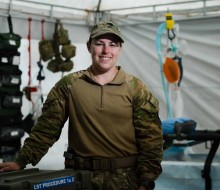
Nelson anaesthetist and soldier part of large multi-national exercise
04 May 2026
Unfortunately you are viewing this website on an outdated browser which does not support the necessary features for us to provide an adequate experience. Please switch to a modern browser such as latest version of Google Chrome, Mozilla Firefox, Apple Safari or Microsoft Edge.
Ngā mihi nui
Located almost 1,400 kilometres north of Rarotonga, with a population of around 200 and supplies shipped every six months, there’s no second trip to the wholesaler for the New Zealand Army’s deployed electricians.
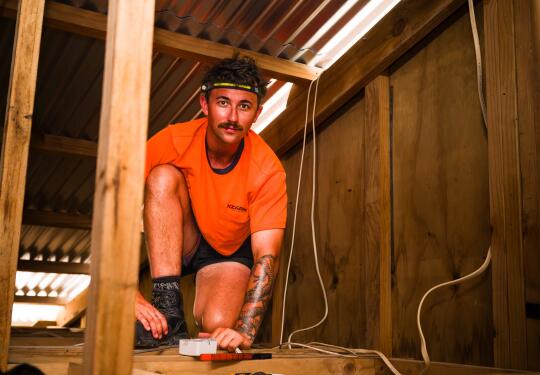
Lance Corporal Ben Falconer is an electrician with 25 Engineer Support Squadron and deployed to Penrhyn in September via a Royal New Zealand Air Force C-130J aircraft for Exercise Tropic Twilight, an annual New Zealand Defence Force (NZDF) Humanitarian Assistance and Disaster Relief exercise in the South-West Pacific, supported by the New Zealand Ministry of Foreign Affairs and Trade.
Now in his first year as a qualified electrician, in Penrhyn, Lance Corporal Falconer experienced an environment very different from a typical job back in New Zealand – one where heat, salt air, flooding, logistics and the remoteness of the island all shape how electrical work is planned and delivered.
It’s not his first experience of electrical work in the Pacific – earlier this year he deployed to Fiji, where his team worked on community infrastructure alongside the Australian Defence Force. On Penrhyn, he was part of a larger NZDF team improving infrastructure across the island.
At Omoka School, one of only two schools on the island, Lance Corporal Falconer and his team replaced an ageing switchboard, upgraded breakers, installed new lighting and power circuits, and ran a sub-circuit to the toilet block for lighting and a pump. They also carried out work at the local hospital replacing lights, including two in the dental room where poor lighting had made treatment difficult.
The team has also been investigating a dental X-ray machine that had not been working for several years. After identifying the fault, they were waiting for parts to arrive to complete the repair.
These changes have lasting impacts across the wider Penrhyn population, and seeing those effects directly is one of the aspects that draws Lance Corporal Falconer to the trade – but he’s found that the technical work is only part of the challenge.
On Penrhyn he has been acting in a section commander role, which meant much of the planning had to be done before the team arrived.There was no electrician on the reconnaissance visit, so Lance Corporal Falconer worked from a priority task list and had to estimate what would be required from New Zealand.
“You’re thinking about every little thing – screws, fittings, saddles, conduit, cable, and then all the tools that go along with that as well.”
Materials cannot simply be replaced at short notice, so planning for a worst-case scenario is needed, and additional materials are added as a contingency.
The environment also changes how some installations are approached. Stainless screws were used to reduce corrosion. Power points were raised to around 1100mm in areas where flooding was a consideration, and IP-rated outlets and switches were installed where moisture could be an issue.
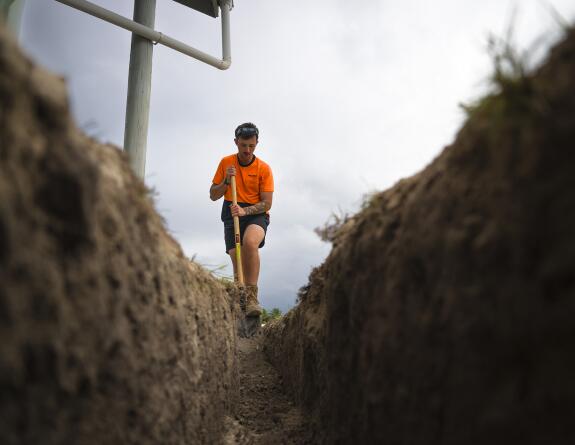
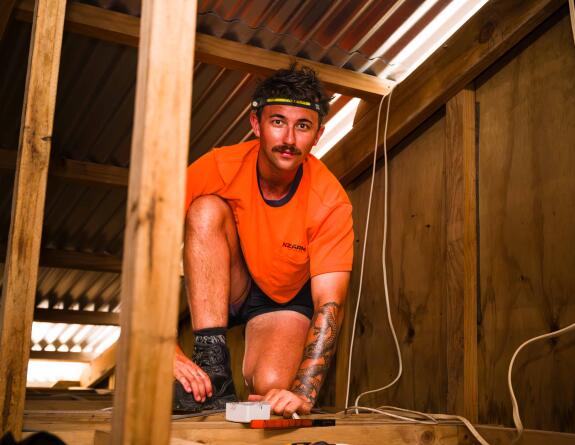

Lance Corporal Ben Falconer on the job and with the locals on Penrhyn
There has also been plenty of problem-solving once on the ground. Much of the work involves working with existing infrastructure rather than new installations, meaning the electricians often do not know exactly what they will find until they open something up.
For example, a lighting circuit at a school had been wired so one light had to be switched on before another would work. In such an isolated location, where supplies may be a six-month barge trip away, a number-eight wire mentality is well and truly exercised by the locals.
“If we find something that isn’t up to standard and we can correct it, obviously we do.”
For Lance Corporal Falconer, that combination of trade skills, problem-solving, and the opportunity to work in places such as Fiji and the Cook Islands is what sets being an Army electrician apart.
“I think joining the NZDF was probably the best decision I made, purely on the fact that you can go overseas and make people’s lives so much better. It might be a small difference to us, but to them it might be massive.”
One of those differences is already visible at Omoka School. The team has installed power, lighting and an oven in a classroom intended for life-skills teaching – something Lance Corporal Falconer said had been planned by the school for some time.
“Knowing these kids will be able to learn there, and seeing how grateful the teachers and principal are, that’s probably been the most rewarding part.”
Lance Corporal Falconer, who hails from Ongaonga, west of Waipukurau and attended Napier Boys High School, has been interested in electrical work since school, particularly through physics and learning how electricity worked. After completing a pre-trade electrical course, he applied to join the Army, initially without realising that the electrician trade was an option. It was his recruiter who made the connection.
“She saw that I’d done my pre-trade and said, ‘Well, you can be an electrician as well,’ which was pretty cool.”
Lance Corporal Falconer went on to complete a four-year electrical apprenticeship through the Army before posting to 2/5 Engineer Support Squadron at Linton Military Camp as a qualified tradesman.
“I always wanted to be an electrician, and I saw the military as a good career path. Once I found out you could do your trade at the same time, it was pretty rewarding.”
That decision has already taken him well beyond the sort of work he might have expected from a conventional apprenticeship.
For someone who knew he wanted to be an electrician from a young age, the NZ Army has given Falconer the trade he wanted, with a workplace that can be considerably harder to predict.
And that, for him, is part of the appeal.
04 May 2026
26 August 2025
14 August 2026
27 July 2026
16 July 2026
08 July 2026
06 May 2026

16 October 2025
09 October 2025