The Victoria Cross (VC)

The Victoria Cross (VC)

Overview

The Victoria Cross (VC) is the highest award in the British honours system. It is granted for valor "in the presence of the enemy" to members of the British Armed Forces and can be awarded posthumously.

Instituted in 1856, the Victoria Cross was also awarded to service personnel across the British Empire (later the Commonwealth of Nations). However, most successor independent nations have since established their own honours systems. The Victoria Cross for New Zealand was instituted in 1999 to replace the British Victoria Cross for future awards to New Zealand military personnel. 

A total of 21 (British) Victoria Crosses and one Bar have been awarded to New Zealanders. Only three servicemen have ever received a second award of the British Victoria Cross. One of these was Captain Charles Upham, New Zealand Army.

Description

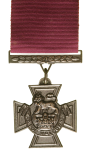
The Victoria Cross was named after Queen Victoria, who personally chose the inscription, 'For Valour'. The bronze cross bears at its centre the Royal Crown, surmounted by a lion.  Below the crown are the words 'For Valour.' The cross is connected by the letter "V" to a straight bronze bar decorated with laurel leaves and suspended on a crimson ribbon.

Originally, the VC ribbon was dark blue for the Royal Navy and crimson for the Army. In 1918, the crimson ribbon was adopted by the Army, Royal Navy, and Royal Air Force. When the ribbon is worn alone, a miniature of the cross is pinned on it.

 A bar can be awarded for a subsequent act of gallantry worthy of recognition by the same level of award. The bars are made of bronze and bear laurel leaves.

Recipients of the medal may use the post-nominal "VC".

Eligibility

The Victoria Cross is awarded for "most conspicuous bravery, or some daring or pre-eminent act of valour or self-sacrifice, or extreme devotion to duty in the presence of the enemy".

Queries & requests

  • Wearing this honour

    The Victoria Cross is worn as a special award in the New Zealand Order of Wear.  It is always worn before the New Zealand Cross.

    For more information on the wear and care of honours, medals, and awards:

  • Nominating someone for this honour

    Since the introduction of New Zealand's own system of Gallantry and Bravery awards in 1999, the Victoria Cross was replaced by the Victoria Cross for New Zealand.

  • Checking if this honour was issued

    Honours, medals, and awards bestowed on an individual for service in the New Zealand Armed Forces are recorded in their individual service record.  NZDF Personnel Archives and Medals holds a collection of about 1.5 million service records relating to 420,000 New Zealand service personnel who served in New Zealand’s Military Forces after the First World War.

    Service records are not currently digitised, but we can locate it and find the information you might be looking for or help you book a time for you to see the records in Trentham by completing the form on the Service Record page. 

    Request a service record