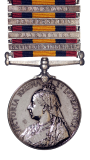
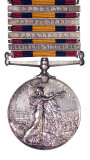
The Queen's South Africa Medal
Overview
Queen Victoria instituted the Queen's South Africa Medal to recognise service in the Boer War in South Africa between 1899 and 1902. On her death in 1901, a new medal called the King's South Africa Medal was struck bearing the effigy of King Edward VII. These medals were the first awarded to New Zealand servicemen for military service outside New Zealand.
Description
There were two strikings of this medal. The initial striking bore the dates 1899-1900. These medals were issued to Lord Strathcona's Horse, which returned to Canada before the end of the war. When the war continued after 1900, the dates were removed from the remaining medals and a new medal was struck without the dates. New Zealand units received the newly struck medal without the dates.
The Queen's South Africa Medal is silver and circular in shape. The medal features the crowned and veiled head of Queen Victoria on the obverse. On the reverse, is Britannia with a flag in her left hand holding out a laurel wreath to a party of advancing soldiers. In the background are two warships. Around the top are the words ‘SOUTH AFRICA’.
A bronze striking of the Queen's South Africa medal was issued to some African, Indian, and West Indian units.
The ribbon has a broad orange central stripe flanked by two dark blue stripes with red edges.
Medals were usually issued with at least one clasp, however, most nurses never received the clasps they were entitled to. Twenty-six clasps were awarded for the Queen's South Africa Medal, twelve of which were awarded to New Zealand military personnel. Two clasps were also awarded for the King's South Africa Medal but were worn with the Queen's South Africa Medal when the recipient was ineligible for the King's Medal.
Listed below are the clasps for the Queen's South Africa Medal. Clasps awarded to New Zealand personnel are marked with an asterisk:
- Cape Colony*
- Rhodesia*
- Relief of Mafeking
- Defence of Kimberly
- Talana
- Elandslaagte
- Defence of Ladysmith
- Belmont
- Modder River
- Tugela Heights
- Natal
- Relief of Kimberly*
- Paardeberg*
- Orange Free State*
- Relief of Ladysmith
- Driefontein*
- Wepener
- Defence of Mafeking
- Transvaal*
- Johannesburg*
- Laing's Nek
- Diamond Hill*
- Wittebergen*
- Belfast
- South Africa 1901*
- South Africa 1902*
Clasps awarded for the King's South Africa Medal that are eligible for wear on the Queen's South Africa Medal are South Africa 1901 and South Africa 1902, both of which were awarded to New Zealand personnel.
Eligibility
The medal was awarded to all who served in South Africa between 11 October 1899 and 31 May 1902.
Important note: This medal is no longer issued by NZDF Personnel Archives and Medals.
Recipients
Ten contingents of the New Zealand Mounted Rifles, totalling 6,128 officers and men, and a contingent of 31 New Zealand nurses served in South Africa. Almost all these persons received the Queen's South Africa Medal.
Queries & requests
-
Related publications
New Zealand Rough Riders. In the South African War 1899-1902 and biographical details of the 10 New Zealand contingents. Richard Stowers (self published, 2015).
-
Wearing this medal
The Queen's South Africa Medal is worn as a war medal in the New Zealand Order of Wear. It is worn after the New Zealand Medal and before the King's South Africa medal.
For more information on how to wear and care for honours, medals, and awards:
-
Checking eligibility and applying for this medal
NZDF no longer issues the Queen's South Africa Medal.
-
Checking if this medal was issued
Honours, medals, and awards bestowed on an individual for service in the New Zealand Armed Forces are recorded in their individual service record. Archives New Zealand(external link) holds a collection of service records for New Zealanders who served in the New Zealand Armed Forces prior to the Second World War. Many of the service records are digitised and easily accessible online.