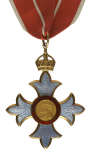
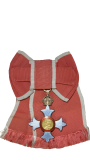
The Most Excellent Order of the British Empire
Overview
The Most Excellent Order of the British Empire was established by King George V in June 1917 for services to the British Empire. The Order has five classes and a medal.
- Knight and Dame Grand Cross (GBE)
- Knight and Dame Commander (KBE / DBE)
- Commander (CBE)
- Officer (OBE)
- Member (MBE)
Prior to the creation of the New Zealand Order of Merit in 1996, the Order of the British Empire was the most common honour for meritorious service awarded to New Zealand military personnel.
Description
A purple ribbon was used for all awards from June 1917 to December 1918. In December 1918 the Order was split into two divisions: a Civil Division for civilian recipients; and a Military Division to the Order for awards to be conferred on commissioned officers and warrant officers for distinguished service in action. Awards for the Military Division distinguished from the Civil Division by a narrow central scarlet stripe on the purple ribbon.
From 1936 onwards, awards under the Civil Division of the Order are suspended from a ribbon of rose-gray, edged with narrow stripes of pearl grey. Awards under the Military Division of the Order are distinguished with a narrow central stripe of pearl-grey.
Between 1957 and 1974, an emblem of silver crossed oak leaves was added to the ribbon of the Commander (CBE), Officer (OBE), and Member (MBE) when the award was made in recognition of an act of gallantry.
Eligibility
Damehood / Knighthood (DBE / KBE) - A pre-eminent contribution in any field of activity (usually, but not exclusively, at national level), or in a capacity which will be recognised by peer groups as inspirational and significant nationally and demonstrates sustained commitment.
Commander of the British Empire (CBE) - A prominent national role of a lesser degree, a conspicuous leading role in regional affairs through achievement or service to the community, or a highly distinguished, innovative contribution in his or her area of activity
Officer of the Order of the British Empire (OBE) - Distinguished regional or county-wide role in any field, through achievement or service to the community including notable practitioners known nationally.
Member of the Order of the British Empire (MBE) - Achievement or service in and to the community which is outstanding in its field and has delivered sustained and real impact which stands out as an example to others.
Queries & requests
-
Wearing this honour
The Most Excellent Order of the British Empire is worn with Orders of Chivalry and Other Orders in the New Zealand Order of Wear. Each class is worn in a different position in the Order of Wear:
- The Knight or Dame Commander of the Most Excellent Order of the British Empire (KBE/DBE) is worn after the Knight, Dame or Distinguished Companion of the New Zealand Order of Merit and before the Knight Bachelor's Badge.
- The Commander of the Most Excellent Order of the British Empire (CBE) is worn after the Commander of the Royal Victorian Order and before the New Zealand Gallantry Star.
- The Officer of the Most Excellent Order of the British Empire (OBE) is worn after the Officer of the New Zealand Order of Merit and before the Companion of the Imperial Service Order.
- The Member of the Most Excellent Order of the British Empire (MBE) is worn after the Member of the New Zealand Order of Merit and before the New Zealand Gallantry Decoration.
For more information on how to wear and care for honours, medals, and awards:
-
Nominating someone for this honour
Since the institution of the New Zealand Order of Merit on 30 May 1996, New Zealand no longer recommends individuals for the various British State Orders of Chivalry (e.g. Orders of the Bath, St Michael and St George and British Empire) and Orders (e.g. the Order of the Companions of Honour), and the honour of Knight Bachelor.
For further information, the Department of Prime Minister and Cabinet has provided a history of the New Zealand Honours System(external link).
-
Checking if this honour was awarded
Honours, medals, and awards bestowed on an individual for service in the New Zealand Armed Forces are recorded in their individual service record. NZDF Personnel Archives and Medals holds a collection of about 1.5 million service records relating to 420,000 New Zealand service personnel who served in New Zealand’s Military Forces after the First World War.
Service records are not currently digitised, but we can locate it and find the information you might be looking for or help you book a time for you to see the records in Trentham by completing the form on the Service Record page.