The British War Medal
Overview
The British War Medal was instituted in 1919 to recognise the successful conclusion of the First World War (1914-1918). Its coverage was later extended to recognise service until 1920, including mine clearing operations at sea, and participating in operations in North and South Russia, the eastern Baltic, Siberia, the Black Sea and the Caspian.
Description
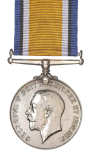
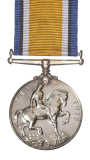
The British War Medal was issued in both silver and bronze. The obverse bears the uncrowned left-facing profile of King George V by Sir Bertram Mackennal. The reverse depicts St George on horseback trampling underfoot the eagle shield of the Central Powers, and a skull and cross-bones (the emblems of death). Above, the sun has risen in victory. The figure is mounted on horseback to symbolise man wielding a force of greater strength than his own, alluding to the scientific and mechanical developments and machines that helped to win the war.
The ribbon consists of an orange watered centre, with thin stripes of white and black at each side, and borders of royal blue.
No clasps were issued for this medal. Although clasps were originally intended, there were so many operational areas and theatres of war that the proposal was abandoned as impractical. The British Army recommended 79 clasps and the Royal Navy recommended 68 clasps. The extensive cost associated with the clasps also appears to have been a significant factor in the decision to issue the medal without clasps. In 1920, naval clasps were authorised in Britain. While miniatures of these clasps are known to exist, the actual clasps were never issued.
Eligibility
Personnel of British and Imperial forces who served for a prescribed period during any stage of the war, or who had died on active service before the completion of this period. Eligibility was subsequently extended to cover service in 1919 and 1920 in mine-clearing at sea as well as participation in operations in North and South Russia, the eastern Baltic region, Siberia, the Black Sea, and the Caspian Sea, during the allied intervention in the Russian Civil War.
For further information:
Army Orders establishing the regulations for the British War Medal can be found at Archives New Zealand(external link). Scans from the Archives files are provided below:
Army Orders 266 and 301, July 1919: the British War Medal and The Victory Medal (PDF, 2.1 MB)
Army Order 392, October 1922: The British War Medal (PDF, 2.4 MB)
Recipients
Throughout the British Empire about 6.5 million medals were awarded in silver. Approximately another 110,000 were awarded in bronze, mainly to Chinese, Indian and Maltese personnel in labour battalions.
Queries & requests
-
Related publications
For more information about First World War medals the following books are recommended:
- Alec A. Purves. The Medals, Decorations and Orders of the Great War 1914-1918. 2nd revised edition (1989)
- Captain H. Taprell Dorling. Ribbons and Medals. 20th edition (1983). Edited and revised by Alec A. Purves
- John Wilson. 'British Battle Clasps of the First World War', in The Volunteers: The Journal of the New Zealand Military Historical Society (Inc), vol.39, no.2, November 2013, pp.94-103.
- John Wilson's article is based on the documents in two files at Archives New Zealand, Wellington:
- - R22433114; was 48/131, Medals, Honours etc: War Medals, Great War, Issue of Clasps
- - R10701469; was 27/133/3, Reinforcements, Battle Clasps (both in Series AAYS, Army Department; formerly Series AD).
-
Wearing this medal
The British War Medal is worn as a war medal in the New Zealand Order of Wear. First World War Medals are worn in the following order:
- The 1914 Star
- The 1914-15 Star
- The British War Medal
- The Mercantile Marine War Medal
- The Victory Medal
For more information on how to wear and care for honours, medals, and awards:
-
Checking eligibility and applying for this medal
Most First World War medals have been issued to service members or their descendants. NZDF Personnel Archives and Medals (PAM) holds only a few remaining First World War medals.
-
Checking if this medal was issued
Most of the war medals for service in the First World War were issued to New Zealand recipients between 1920 and 1924, including to the next-of-kin of the more than 18,000 New Zealand service personnel who died as a result of war service. Nearly all the remaining medals were claimed by the individuals or their immediate family before 1970.
You can check the medal entitlements of a relative who served in the First World War by looking at the online version of their military service file held by Archives New Zealand.(external link) Search the site using the full name of your relative. Once you have downloaded the file, you can find the medal entitlement and the dates the medals were issued on the History Sheet.
If a First World War medal has been issued but cannot be found, the NZDF cannot replace it and does not sell replica (copy) medals. Duplicate or replacement medals can be purchased from various medal dealers in New Zealand -- search online for "replica medals country:nz". Miniatures of First World War medals can also be purchased online directly from our supplier, Eng Leong Medallic (ELM).
IMPORTANT NOTE: Medals issued to descendants of servicemembers after the digitalisation of service records at Archives New Zealand will not be recorded on the digitised service record.