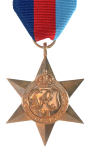
The 1939-1945 Star
Overview
The 1939-1945 Star is the first in a series of eight campaign stars instituted in 1945 to recognise service in the Second World War.
Description
The 1939-1945 Star is bronze and shaped like a six-pointed star. At the centre is a circle bearing the Royal Cypher "GRI VI". The cypher is surmounted by the Tudor crown and encircled by the inscription 'The 1939-1945 Star'.
The ribbon has three equal vertical stripes of dark blue, red and light blue. The dark blue stripe symbolises the service of the Navy and the Merchant Navy, the red stripe symbolises the service of the Army, and the light blue stripe symbolises the service of the Air Force.
Two clasps were issued with this medal. The ‘Battle of Britain' clasp was awarded to aircrew who saw service during the Battle of Britain in 1940. When ribbons only were worn on military uniform, a gilt rose emblem on the ribbon denoted the award of this clasp. The 'Bomber Command' clasp, instituted in 2013, recognises those who served with a UK-based Bomber Command Unit between 3 September 1939 and 8 May 1945.
The medal was issued unengraved, as were other Second World War campaign medals. Among the British Commonwealth countries, only Australia and South Africa engraved the 1939-1945 Star.
Eligibility
For service on land, the medal was awarded for six months (180 days) service in specified operational areas. Those whose service was shortened by death, injury or capture or who were awarded a decoration or mention in despatches also qualified for the Star.
For service at sea by Navy and Merchant Navy personnel, the medal was awarded for 180 days ‘service afloat in areas of active operations (dangerous waters)’ between 3 September 1939 and 2 September 1945. From 10 June 1940 to 8 May 1945 ‘dangerous waters’ are defined as ‘anywhere at sea’. Army and Air Force personnel who were posted for duty to His Majesty' warships and other commissioned ships also qualified under the same criteria.
Aircrew who had 'taken part in operations against the enemy' and completed two months (60 days) in 'an operational unit' also qualified for the 1939-1945 Star.
Battle of Britain Clasp Eligibility
- service as aircrew on a fighter aircraft.
- engagement in the Battle of Britain between 10 July 1940 and 31 October 1940.
Bomber Clasp Eligibility
- service as aircrew with a UK-based Bomber Command Unit between 3 September 1939 and 8 May 1945
-
Served as aircrew on a Bomber Command operational unit for at least 60 days, or completed a tour of operations; and
- Flew at least one operational sortie.
IMPORTANT NOTES:
- The above criteria mean that eligible personnel will have already qualified for the 1939-45 Star.
- The Bomber Command clasp may also be issued in respect of Bomber Command aircrew who do not meet the above qualifying criteria but had their service brought to an end by death, wounds, or other disability due to service; or received a gallantry award for their Bomber Command service; or were taken as a prisoner of war.
The full eligibility criteria for the eight Second World War campaign stars (instituted before 1947) and the two British war service medals can be viewed in the 1947/48 British Army publication Campaign Stars and Commemorative Medals instituted for the 1939-45 War. (PDF, 3.4 MB) The attached pdf includes New Zealand Army handwritten annotations.
Queries & requests
-
Recipients
Up to 6,000 NZ Armed Forces personnel served as aircrew in Bomber Command. Since 2013, NZDF has issued more than 330 Bomber Command Clasps.
-
Wearing this medal
The 1939-1945 Star is worn as a war medal in the New Zealand Order of Wear. It is the first of the Second World War medals and is always worn before the Atlantic Star.
For more information on how to wear and care for honours, medals, and awards:
-
Applying for this medal
NZDF Personnel Archives and Medals (PAM) issues war, operational and service medals to current and former NZDF members.
If you or someone you know may be eligible, you can apply through our application page.
-
Checking if this medal was issued
Honours, medals, and awards bestowed on an individual for service in the New Zealand Armed Forces are recorded in their individual service record. NZDF Personnel Archives and Medals holds a collection of about 1.5 million service records relating to 420,000 New Zealand service personnel who served in New Zealand’s Military Forces after the First World War.
Service records are not currently digitised, but we can locate it and find the information you might be looking for or help you book a time for you to see the records in Trentham by completing the form on the Service Record page.