The 1914-15 Star
Overview
The 1914–15 Star was authorised in 1918 to recognise service in the First World War (1914-1918). It was awarded for service in any theatre of the Great War between 5 August 1914 and 31 December 1915.
Initially this medal was not going to be awarded for service at Gallipoli. Instead, it had been proposed by Lieutenant General Birdwood in October 1917 that a Gallipoli Star (originally to be called the ANZAC Star) should be awarded to members of the Australian Imperial Force and 1NZEF who served at Gallipoli. King George V approved the idea the following month. However, by August 1918 when the design of the star and the conditions for award had been finalised, and stocks of ribbon forwarded to New Zealand and Australia, the proposal was reviewed by the British government following criticism from both members of Parliament and the media in the United Kingdom, who were uneasy about British and other forces of the Empire being ineligible for the proposed star. After consultation with the Australian and New Zealand governments, the British War Cabinet agreed that the 1914-15 Star would be awarded to all personnel who had served at Gallipoli. (Source: Ian McGibbon (ed), The Oxford Companion to New Zealand Military History (Oxford University Press, Auckland, 2000), p.226).
In 1967 the Australian and New Zealand governments jointly agreed to issue an ANZAC Commemorative Medallion (which was not designed to be worn) to all veterans and the next of kin of veterans who had served at Gallipoli.
Description
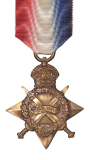
The 1914-15 Star is a crowned four-pointed star with crossed swords and a wreath of oak leaves, with the royal cypher at the foot and a central scroll inscribed 1914-15. On the reverse are the recipient's inscribed name and service details. The medal is bronze and is attached to the ribbon by a ring.
The ribbon is watered silk with red, white, and blue stripes.
This medal is similar to the 1914 Star. However, the central scroll on the 1914 Star is inscribed "AUG NOV 1914."
Eligibility
Servicemen and servicewomen who served between 5 August 1914 and 31 December 1915 in any "theatre of war", provided they had not qualified for the 1914 Star.
This included service at Gallipoli between 25 April 1915 and 31 December 1915, service in Egypt between 5 November 1914 and 31 December 1915, and service during the capture of German Samoa on 29 August 1914. Those eligible for the medal must have "served on the establishment of a unit in a theatre of war" during the relevant dates of operations in that area.
Recipients
Throughout the British Empire more than 2.35 million 1914-15 Stars were awarded.
Queries & requests
-
Related medals and awards
Personnel who served at Gallipoli (who have been awarded the 1914-15 Star) are also entitled to the ANZAC Commemorative Medallion, which was instituted in 1967. The ANZAC Commemorative Medallion had to be applied for in writing, so some recipients (or their next-of-kin) have not yet claimed the medallion.
The issue of the ANZAC Commemorative Medallion is normally, but not always, recorded on the digitised version of the person's military file held at Archives New Zealand.(external link) Search the site using the full name or service number of your relative. Once you have downloaded the file, you can find the medal entitlement and the dates the medals were issued on the History Sheet.
If you believe that the ANZAC Commemorative Medallion has not been issued, please visit our Medals Applications to download the medals application.
-
Related publications
For more information about First World War medals the following books are recommended:
- Alec A. Purves. The Medals, Decorations and Orders of the Great War 1914-1918. 2nd revised edition (1989)
- Captain H. Taprell Dorling. Ribbons and Medals. 20th edition (1983). Edited and revised by Alec A. Purves
-
Wearing this medal
The 1914-15 Star is worn as a war medal in the New Zealand Order of Wear. First World War Medals are worn in the following order:
- The 1914 Star
- The 1914-15 Star
- The British War Medal
- The Mercantile Marine War Medal
- The Victory Medal
For more information on how to wear and care for honours, medals, and awards:
-
Checking eligibility and applying for this medal.
Most First World War medals have been issued to service members or their descendants. NZDF Personnel Archives and Medals (PAM) holds only a few remaining First World War medals.
-
Checking if this medal was issued
Most of the war medals for service in the First World War were issued to New Zealand recipients between 1920 and 1924, including to the next-of-kin of the more than 18,000 New Zealand service personnel who died as a result of war service. Nearly all the remaining medals were claimed by the individuals or their immediate family before 1970.
You can check the medal entitlements of a relative who served in the First World War by looking at the online version of their military service file held by Archives New Zealand.(external link) Search the site using the full name of your relative. Once you have downloaded the file, you can find the medal entitlement and the dates the medals were issued on the History Sheet.
If a First World War medal has been issued but cannot be found, the NZDF cannot replace it and does not sell replica (copy) medals. Duplicate or replacement medals can be purchased from various medal dealers in New Zealand -- search online for "replica medals country:nz". Miniatures of First World War medals can also be purchased online directly from our supplier, Eng Leong Medallic (ELM).
IMPORTANT NOTE: Medals issued to descendants of servicemembers after the digitalisation of service records at Archives New Zealand will not be recorded on the digitised service record.