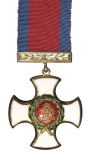
The Companion of the Distinguished Service Order (DSO)
Overview
The Distinguished Service Order (DSO) was instituted in 1886 to recognise acts of gallantry by military officers for which a Victoria Cross was not considered appropriate. In 1942 the regulations were amended to allow the award to be made to officers of the Merchant Navy for gallantry in the presence of the enemy. Following a UK review of gallantry awards in 1993, the purpose of the DSO was changed to recognise outstanding leadership at all ranks. The DSO was awarded to over 300 New Zealanders during both World Wars. The DSO is no longer awarded in New Zealand since the introduction of New Zealand's own system of Gallantry and Bravery awards in 1999.
Description
The Companion of the Distinguished Service Order is a white enameled cross with rounded and golden edges. The obverse features a central red enameled medallion bearing the Royal Crown in gold and encircled by a green enameled laurel wreath. The reverse bears a golden Royal Cypher upon the red enameled medallion encircled by a laurel wreath.
The ribbon is red with narrow blue edges.
Bars were awarded for subsequent acts of gallantry. Lieutenant General Sir Bernard Freyberg received the DSO and three bars.
Eligibility
Initially, the Distinguished Service Order was awarded to military officers for acts of gallantry that did not merit the Victoria Cross. Since 1993, it has been awarded to recognise outstanding leadership at all ranks.
Queries & requests
-
Related publications
- Haigh, J. Bryant and Polaschek, Alan J. New Zealand and the Distinguished Service Order (1993) (468 pages), published by Medals Research.
- Creagh, Sir O'Moore (until 1920) and Humphris, E. M. (editors). The V.C. and D.S.O.: A complete record of all those officers, non-commissioned officers, and men of His Majesty's naval, military, and air forces who have been awarded those decorations (published in three volumes, ca.1924.) Volume I records the awards of the Victoria Cross; Volumes II and III record the awards of the Distinguished Service Order. Each entry contains biographical information, descriptions of the deeds of valour which earnt the awards, and often a photograph or portrait of the recipient. Reprinted in 1978 by J.B. Hayward in two volumes: the first entitled The Victoria Cross, 1856-1920; the second entitled The Distinguished Service Order, 1886-1923.
- Sutherland, James. The Distinguished Service Order, 1924-2008 (2009) (530 pages), published by Savannah, London. This book contains information on more than 4,800 Commonwealth recipients, including New Zealanders. Recipients are listed alphabetically by surname.
-
Wearing this award
The Companion of the Distinguished Service Order is worn with Orders of Chivalry and Other Orders in the New Zealand Order of Wear.
For more information on how to wear and care for honours, medals, and awards:
-
Checking eligibility and applying for this award
The DSO is no longer awarded in New Zealand since the introduction of New Zealand's own system of Gallantry and Bravery awards in 1999.
-
Checking if this award was issued
Honours, medals, and awards bestowed on an individual for service in the New Zealand Armed Forces are recorded in their individual service record. NZDF Personnel Archives and Medals holds a collection of about 1.5 million service records relating to 420,000 New Zealand service personnel who served in New Zealand’s Military Forces after the First World War.
Service records are not currently digitised, but we can locate it and find the information you might be looking for or help you book a time for you to see the records in Trentham by completing the form on the Service Record page.