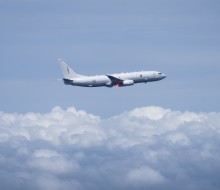
Royal New Zealand Air Force joins anti-submarine warfare exercise in Guam
10 March 2026
Unfortunately you are viewing this website on an outdated browser which does not support the necessary features for us to provide an adequate experience. Please switch to a modern browser such as latest version of Google Chrome, Mozilla Firefox, Apple Safari or Microsoft Edge.
Ngā mihi nui
A recent exercise across the Tasman provided New Zealand Army personnel with a valuable opportunity to deploy bulk fuel capabilities with their Australian counterparts on Exercise Overland Nautical Petros.
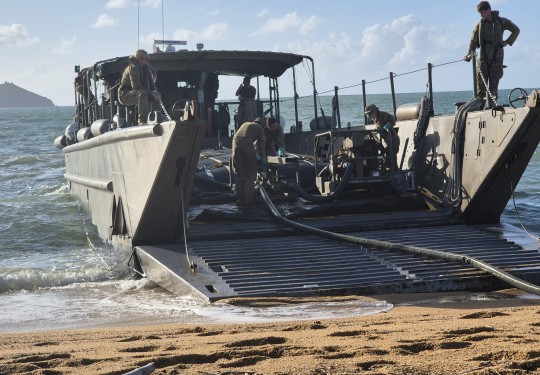
Soldiers drawn from across 1st (New Zealand) Brigade embedded with units from the Australian Army’s 17th Sustainment Brigade for the annual exercise, which was designed to test their full suite of bulk fuel capabilities.
Being able to store and distribute fuel in the field away from fixed infrastructure is a critical capability for any armed force to sustain operations and ensure soldiers can continue advancing forward.
Captain Sean Squires led the NZ Army team and said the two-week exercise proved incredibly valuable.
“It provided significant training opportunities for our contingent, offering exposure to capabilities, systems, and operational environments that we don’t have in New Zealand. Integrating with Australian Defence Force Petroleum Operators allowed NZ personnel to both observe and participate in a wide range of critical deployable bulk fuel operations,” Captain Squires said.
Challenging conditions and the tough Australian environment added to the learning experience.
“It proved demanding with temperatures averaging 30 degrees Celsius and high humidity levels. Combined with hostile wildlife including snakes, cassowary, sharks and spiders, the training area up at Cowley Beach (Queensland) introduced us to new challenges in the field environment that our junior Petroleum Operators are unlikely to have previously experienced.”
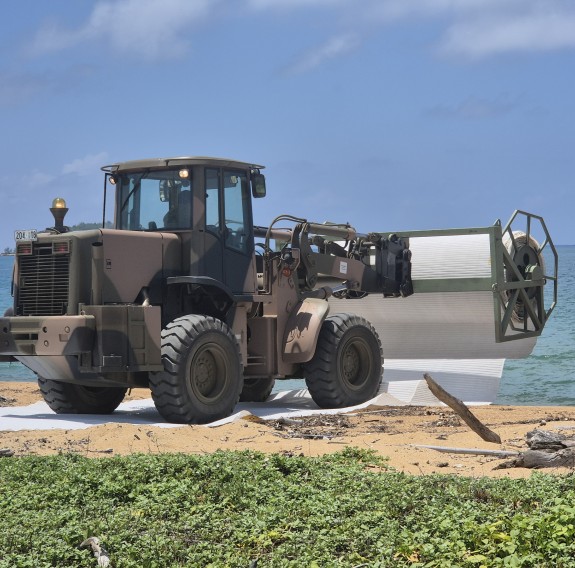
A Caterpillar IT28B lays down trackway matting in preparation for an amphibious landing craft to approach.
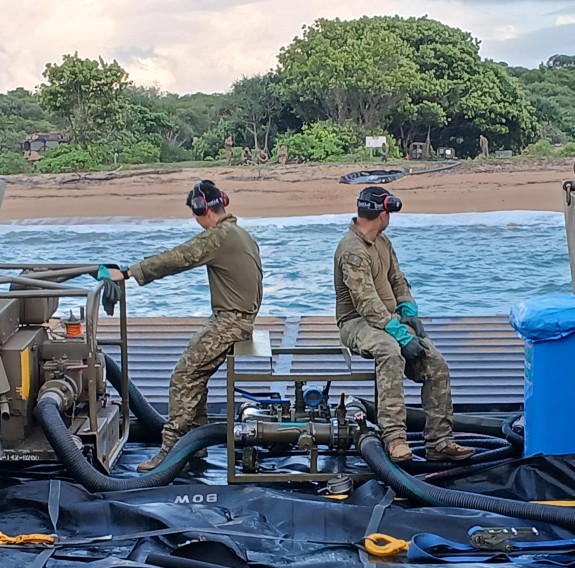
Soldiers aboard a landing craft prepare to approach the beach to pick up fuel.
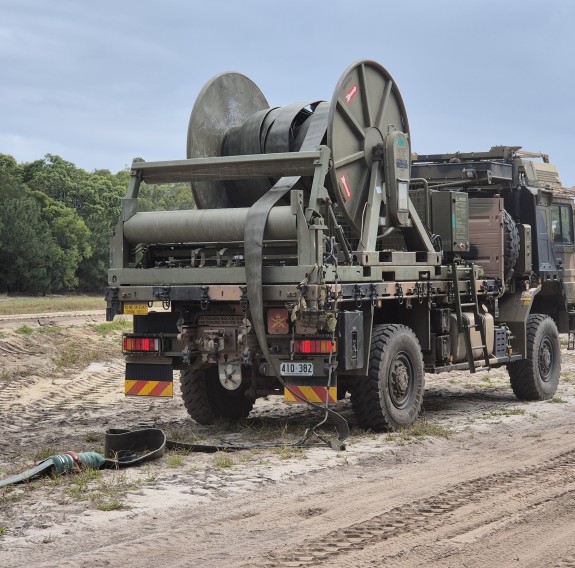
A HX60 from the Australian Army’s 17th Brigade lays down 2.5km of lay-flat hoses for the transfer of fuel between storage areas.
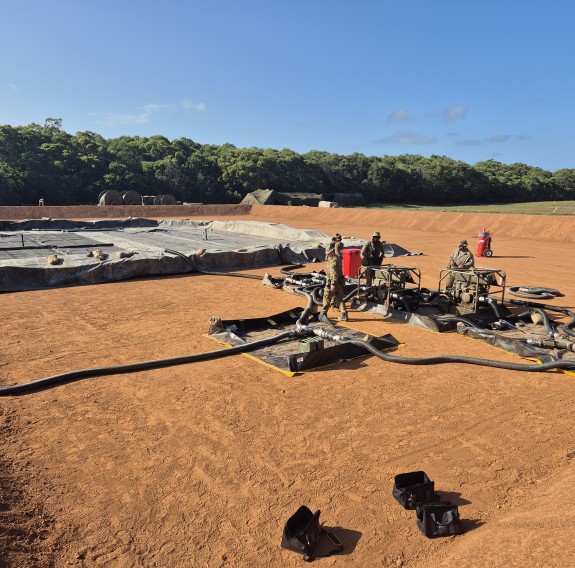
Petroleum Operators set up the main bulk fuel instillation during Exercise Overland Nautical Petros.
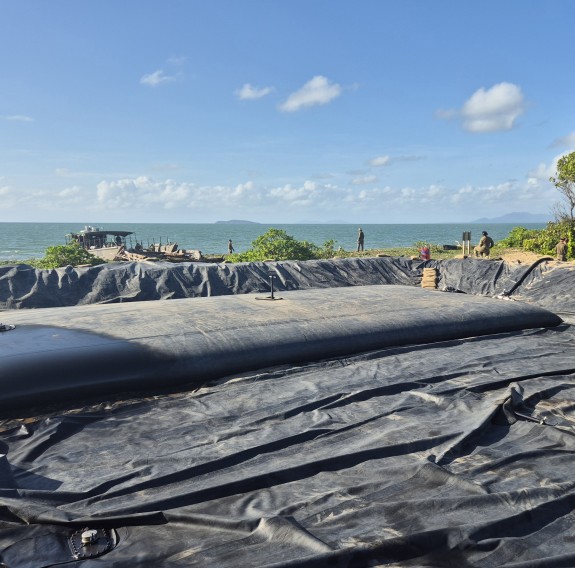
The Beach Storage Area with two tanks, one empty and one full. The LCM-8 can be seen in the background connecting to the system.
While some of the capabilities are replicated across both armies, the bulk fuel instillations established during the exercise were at a scale that cannot be replicated here.
“When we look at our capacity for example, we can establish temporary bulk fuel instillations capable of holding up to 90,000 litres, whereas during this exercise we were able to reach nearly half a million litres (470,000L),” Captain Squires said.
“But beyond just scale, we’ve also had the chance to see how our partners have modified some equipment and found ways to get some really impressive capabilities up and running, which we know are vital for fuelling any fight.”
Among the equipment used by the Australian Army’s 17th Sustainment Brigade were Landing Craft Mechanised, Mark 8 (LCM-8) that carried a modified collapsible tank for transiting fuel.
These were able to unload fuel directly into a Beach Storage Area where the fuel was then pumped 2.5 kilometres inland to the main Bulk Fuel Instillation.
“Being able to navigate the hurdles and challenges of transporting fuel across the littoral space from sea to land is a game-changing capability, particularly as it relates to our geography in the South West Pacific.”
The exercise also showed how interoperable NZ Army Petroleum Operators were with the Australian system.
“It showed despite difference coursing and trade structures, our people can deploy effectively alongside their Australian counterparts without requiring additional cross-training, and could integrate seamlessly into their establishment through some on-the-job training — the exercise was a huge success for us.”
10 March 2026
07 February 2026
08 December 2025
25 July 2025
31 March 2026
26 February 2026
11 December 2025
13 November 2025
21 October 2025