Sikhs in the Royal New Zealand Navy balance military service and faith
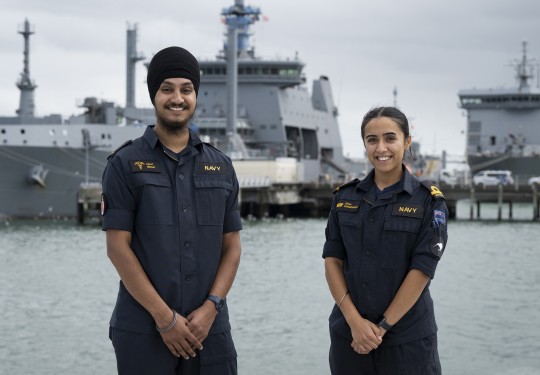
Two Sikhs have praised the Royal New Zealand Navy for its acceptance and flexibility as they embrace new careers alongside their religion.
23 March, 2026
Ordinary Medical Assistant Ajeet Singh and Sub Lieutenant Simar Choudhary are relatively new to the Navy, with Ordinary Medical Assistant Singh graduating in 2023 and Sub Lieutenant Choudhary less than three months ago.
Ordinary Medical Assistant Singh is from south Auckland and joined the Navy immediately after finishing at Auckland Grammar School. He follows his older brother, who serves in the Royal New Zealand Air Force.
He is the only baptised Sikh in the Royal New Zealand Navy. Articles of his faith include not cutting his hair, wearing a turban and carrying a kirpan, a small dagger.
He said the Navy was very accepting towards the requirements of his faith.
“Honestly, they were really accommodating and open to everything. We had one instance where I was told my kara (wrist bangle) was jewellery and couldn’t be worn on parade. Once I explained it was part of my faith it was fine.”
Throughout his basic training he kept a smaller version of his dagger wrapped up in his turban.
Finding the balance is a two-way street, he said.
“I would be given a time extension after physical training to re-tie my turban, and it’s about integrity, about not taking advantage of extras like that.”
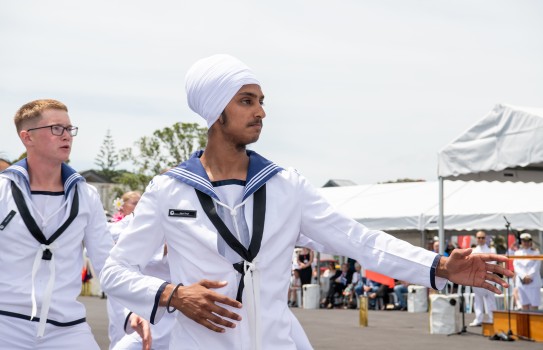
Ordinary Medical Assistant Singh performs the Navy haka at his graduation in 2023.
Devout Sikhs read five scriptures in the morning, one in the afternoon and one before bed.
“They were very accommodating with that, with specific times set aside and a room made available. One of my classmates was Muslim and she received the same thing. It was the same with food. I choose to be vegetarian and the Navy has always been very accepting of my dietary requirements.”
He took advantage of his older brother going into service ahead of him, getting tips on adjusting the tie of the turban to sustain the rigors of training and working with helmets.
“I would tell others that follow me that, yes, there are obstacles, but there are ways around them. The New Zealand Defence Force (NZDF) is accommodating; you have to put in your bit as well.
“You can do your job, be safe and have your faith.”
Sub Lieutenant Choudhary, who graduated from officer training in December, was born in Auckland but spent much of her life in Delhi, moving back to New Zealand for university.
She is a trainee psychologist with the Navy. Like Ordinary Medical Assistant Singh, she doesn’t cut her hair but chooses not to wear a turban.
She said she never felt at any disadvantage in coming from a different culture.
“I feel genuinely included and safe to be my authentic self, without needing to change or mask who I am.”
People could feel daunted about the idea of joining the NZDF, regardless of culture, but they didn’t need to be, she said.
“It is a very inclusive, respectful and safe environment, where people value your personality and what you bring. They value your ‘superpowers’. It’s a close-knit organisation that cares about its people.”
Both Ordinary Medical Assistant Singh and Sub Lieutenant Choudhary were drawn to the Navy by the idea of travel and deployments to interesting places, but training came first.
Ordinary Medical Assistant Singh has since been inspired by other critical trades and is now retraining as an Electronics Technician.
Sub Lieutenant Choudhary will undertake an 18-month Supervision to Registration Programme through the NZDF Directorate of Psychology, culminating in her registration as a psychologist with the New Zealand Psychologists Board.
“The NZDF is an ideal place for a career in psychology. It builds broad experience, instils the discipline to keep studying and growing, and equips you with tools and skills that are valuable in any psychology field.”
Ordinary Medical Assistant Singh’s advice to others was more practical.
“Do sciences and maths at school and start getting fit – the sooner the better.”