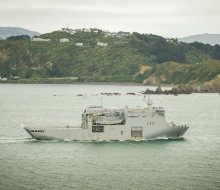
HMNZS Canterbury’s fourth capital visit this year highlights ship’s critical Defence role
29 August 2025
Unfortunately you are viewing this website on an outdated browser which does not support the necessary features for us to provide an adequate experience. Please switch to a modern browser such as latest version of Google Chrome, Mozilla Firefox, Apple Safari or Microsoft Edge.
Ngā mihi nui
A Royal New Zealand Air Force (RNZAF) P-8A Poseidon has launched Harpoon missiles for the first time during an international exercise near Guam.
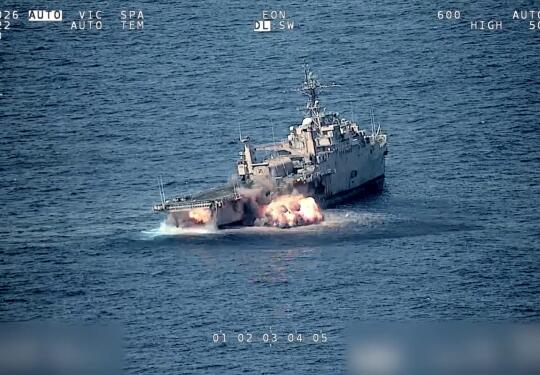
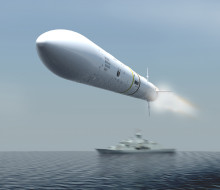
In coordination with a Royal Australian Air Force (RAAF) Poseidon and two United States Navy Poseidons, the New Zealand aircraft and crew from No. 5 Squadron successfully detected, identified and fired two AGM-84 Harpoon guided missiles at a decommissioned target ship, with both missiles hitting the target.
It was part of multi-domain Exercise Valiant Shield involving aircraft, ships and submarines from New Zealand, Australia, Canada, Japan and the United States.
The live-fire exercise used weapons fired from the air, surface vessels and submarines to sink the ship.
“This exercise marked a significant step forward for the RNZAF with the first successful launch of air-to-surface missiles by our P-8A,” Air Component Commander, Air Commodore Andy Scott said.
“These activities are critical to the New Zealand Defence Force’s readiness to be able to meet the challenges of a deteriorating strategic environment, and we are incredibly grateful for the support of partners to assist us in regenerating the ability to rapidly strike targets at distance.”
The P-8A Poseidon can be armed with Harpoon anti-ship guided missiles, used to strike ships accurately from at least 100 kilometres away. The successful firing of the missiles, supplied by the Australian Defence Force, demonstrates the fleet’s utility as a strike capability against surface targets.
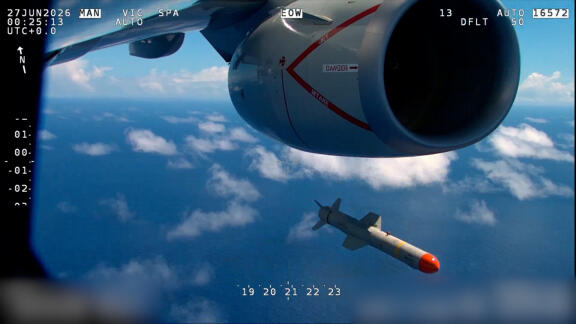
P-8A Poseidon fires Harpoon | Royal New Zealand Air Force
Air Commodore Scott said as with all weapons, it was hoped they wouldn’t need to be used.
“But part of military readiness is having the ability to do so if called upon and this is not something you can generate overnight.
“This firing has been the culmination of a lot of work across multiple parts of Defence and we would not have been able to rebuild so quickly without the support of our Australian and US partners.”
Poseidon captain, Squadron Leader Michael Craies, says the missile firing success was thanks to a large team effort.
“As we felt the weapons fall from the airframe and watched the Harpoon missiles strike their target, we knew it was the work of so many people across the RNZAF and our partners that made it possible.
“The first successful Harpoon firing from our P-8A is a testament to our armament, maintenance, and logistics personnel.”
The coordinated missile firings between one RNZAF and two United States Navy Poseidons highlighted the ability to work seamlessly with a partner, Squadron Leader Craies said.
“When the time came for our firing, the professionalism of all three P-8A crews involved meant that we were able to rapidly acquire the target and fire four Harpoons in total.”
This is the first time an RNZAF Poseidon has taken part in Valiant Shield, which started in 2006 and is in its 11th iteration this year.
The countries involved worked closely together to test tactics and procedures, and develop interchangeability and interoperability in the air, space, sea, land and cyberspace domains.
During the anti-submarine warfare phase of the exercise, the RNZAF Poseidon operated as part of a task force to find, track and conduct simulated MK54 torpedo attacks against multiple submarines.
The task force included a RAAF Poseidon, US Navy Poseidons, the Canadian frigate HMCS Charlottetown, Japanese Maritime Self-Defense Force’s JS Kaga and JS Fuyuzuki, and the United States’ George Washington Carrier Strike Group.
29 August 2025
08 August 2026

19 February 2026
12 May 2025
07 March 2025
26 November 2024
23 April 2024
01 December 2023
11 August 2023