Remembering River Plate
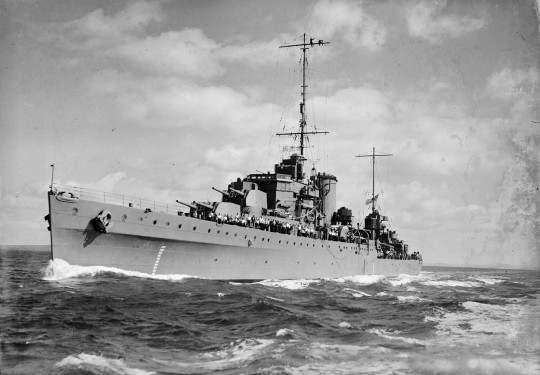
More than 320 New Zealand naval officers and ratings were aboard the cruiser HMS Achilles when it joined the hunt for a German ‘Pocket Battleship’ in the South Atlantic.
13 December, 2025
In the weeks leading up to the outbreak of World War II, the German cruiser KMS Admiral Graf Spee had been deployed to the South Atlantic sea lanes ready to begin attacking merchant shipping once war began. Following the declaration of war on 3 September 1939, Graf Spee began commerce raiding - attacking and sinking nine merchant ships in the Indian Ocean and off the coast of South Africa.
However, the Royal Navy’s search for Graf Spee was stepped up considerably when it was learned the ship was heading towards South America and, possibly, the River Plate estuary – the most congested part of the South Atlantic shipping routes and offering rich targets.
The South American Cruiser Squadron of the Royal Navy compromised HM Ships Cumberland, Exeter, Ajax and Achilles. Achilles (later to be commissioned HMNZS Achilles) had a complement of 567 of which five officers and 316 ratings were New Zealanders.
At 0530 on 13 December 1939, smoke was sighted on the horizon and the Graf Spee was positively identified. A fierce battle ensued. Ajax and Achilles each mounted eight 6-inch guns and Exeter had six 8-inch guns. Graf Spee, known as a ‘Pocket Battleship’, was armed with six 11-inch guns and eight 5.9-inch guns. While the Royal Navy ships had a speed advantage, the German’s guns had a longer range and more destructive firepower.
With Achilles and Ajax attacking from one side and Exeter the other, Graf Spee concentrated its fire on the more heavily armed Exeter causing significant damage and heavy casualties. Achilles and Ajax also took damage.
Exeter did deal a decisive blow, however, when a shell from the ship penetrated two decks of Graf Spee and exploded destroying the fuel processing system. With only 16 hours of fuel remaining and the loss of some of its armament, the Graf Spee’s captain Hans Langsdorff, made the decision to turn towards the neutral port of Montevideo in Uruguay.
The international laws of neutrality governed the length of time a warship could seek refuge in neutral port – usually 24 hours. Graf Spee was given an additional 72 hours to effect repairs and depart.
While in port, Langsdorff was told by the German Admiralty that a break-out was authorised but that he was not to allow the ship to be interned.
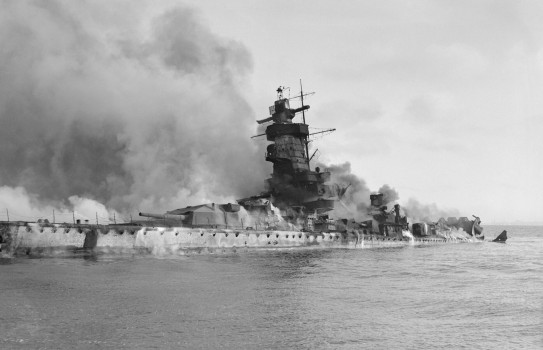
At the same time, Langsdorff had been getting false reports of a superior British naval force being assembled. Low on ammunition, and with a fuel disadvantage, he was not confident his ship could win any subsequent battle but equally did not want the ship to fall into British hands.
Four days after the battle, Graf Spee left harbour and was scuttled by a skeleton crew in the River Plate estuary. Langsdorff clearly thought this was a more honourable solution as he was quoted as saying “To me 1,000 young men alive are worth more than 1,000 dead heroes”. The Graf Spee’s crew were subsequently interned in Argentina.
Following the scuttling, Captain Langsdorff lay down on the Graf Spee’s battle ensign in his hotel room in Buenos Aires and shot himself.
During the battle, 61 sailors on Exeter, seven on Ajax and four on Achilles were killed. The deaths on Achilles were caused by shrapnel when an 11-inch shell from Graf Spee fell short and exploded on hitting the water. The four dead were buried at sea the following day. In a tragic postscript, two of these bodies were washed ashore and subsequently reinterred at the Buceo British Cemetery in Montevideo.
The return of Achilles to New Zealand in early 1940 was met with huge public excitement, including parades in Auckland and Wellington.
The Y-turret from HMNZS Achilles stands outside the Devonport Naval Base and watches over all who pass through the gates of the Home of the Royal New Zealand Navy as a memorial to those who lost their lives.