National resilience a key to national disasters, offshore attacks
In a deteriorating global environment and increasingly powerful weather events, New Zealand is at increased risk of cyber-attacks, disinformation tactics, military conflict and devastating natural catastrophes.
01 September, 2026
Experts say we need to combat these with a whole-of-society approach, so the New Zealand Defence Force (NZDF) has been working alongside a wide range of organisations, academic experts and local and central government departments as part of a national resilience strategy, should a natural or manmade disaster hit the country.
The concept of national resilience has been led by Swedish Defence Attaché Lieutenant Colonel Jan Eideblad. Over the past month he brought together a number of industries to examine lessons from Sweden’s Total Defence model and to consider what a New Zealand approach to societal readiness could look like.
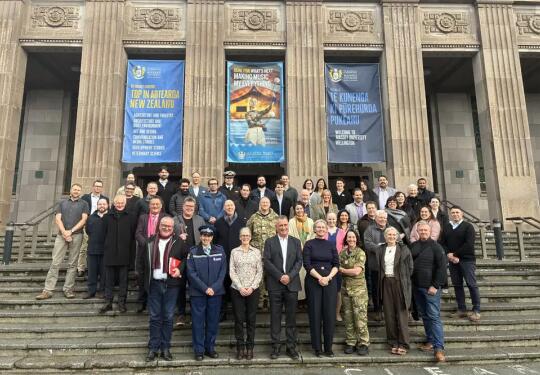
The activities culminated in a tabletop exercise at Massey University involving 90 people from a range of sectors, including Defence.
Royal New Zealand Air Force (RNZAF) psychologist Wing Commander Carolyn Pezaro led the NZDF’s contribution in the engagements.
“My role at the NZDF is looking at how we protect ourselves from malign influence online, what NATO is calling cognitive warfare. One of the difficulties and problem sets we're facing in the modern environment is that that type of activity is targeting the whole of society.
“We anticipate, especially in information warfare, that some of the crisis we need to be resilient against are cyber-attacks, especially on key infrastructure. that could be crippling to our society - for example, if a cyber-attack took out banking networks and internet banking.”
The recently released NZSIS Threat Assessment highlighted that some communities in New Zealand were being targeted by foreign interference, Wing Commander Pezaro said.
“It also notes the growing challenge posed by generative AI, which can be used to create convincing synthetic content and deepfakes that amplify polarising narratives, obscure the true source of information, and contribute to social division.”
During the tabletop exercise at Massey, the participants were pulled into a fictional war where disparate events were happening, such as a cyber-attack, a transatlantic cable was cut and trade routes were blocked.
Each of the nine groups involved in the exercise dealt with each scenario separately, but as new information was added to the exercise it resulted in everyone understanding it was a coordinated attack and priorities needed to be made to keep the country safe, she said.
“It was designed to create an environment where we had to ruthlessly prioritise decisions like giving a finite amount of oil to hospitals, or the military or to the transport industry, with a deadline of just a few minutes.”
Those involved in the exercise realised quickly that New Zealand had been too slow in implementing this type of planning. It was also the first time all the different groups had worked together in that type of scenario, Wing Commander Pezaro said.
“What was different about this is we pulled in industry, academia, councils and iwi. Next time, hopefully there will be an even broader audience.
“Often during natural disasters like a flood or an earthquake, local marae will offer shelter, so they also need to be included in the planning process or the training or the war gaming. If we have a storm that takes out our national infrastructure, we need to bring in the energy companies and the linesmen.”
The country also needs to understand better how many supplies we have on hand should our trade routes be blocked off, she said.
“How many critical supplies do we have stocked up like medical supplies? How long can we last if we can't get any diabetic medication? Or fuel? It was timely to do this exercise with the global situation as it is.”
“The benefit of the exercise was we had the people, who wouldn't usually be involved in national security, thinking about what if we went to war. As a Defence Force we need the public to start paying attention to signs of global instability.”
Wing Commander Pezaro hoped the activity would be an annual event, covering a range of complex scenarios.